Wednesday, July 7, 2010

The Vuvuzela Gees

Hello Everyone,

When I arrived in Johannesburg a month ago, someone asked me if I could feel the gees (an Afrikaans word rhyming with “see us” and pronounced using 12 muscles in the back of your throat). I quickly learned that gees means “spirit” and in this case, referred to the nationwide atmosphere that is accompanying the World Cup festivities. To be honest, I am usually not a gung-ho participant in spirit-oriented activities. My least favorite event in high school after prom was Spirit Week because I found it so stressful to think of creative outfits to wear. Couldn’t we forget all this nonsense and just get on with our learning? (I have since learned how to have fun which I’m sure has been a significant relief to most people around me.)

The spirit here, however, seems a bit different. People are comparing it to the elections in 1994 or the Rugby World Cup in 1995, which the movie Invictus dramatized. In the Apartheid Museum in Johannesburg, we were told that under the old government, one way to tell what race a man was by the sport he played. White people played rugby; black people played soccer. The Springboks (the national rugby team) was white; Bafana Bafana (the national soccer team) was black. The two teams are still mostly divided along racial lines, but it is a sign of how far this country has come to see how uniformly South Africans participate in the excitement surrounding the tournament. Everyone, it seems, has some kind of Bafana Bafana paraphernalia. Black and white take a back seat to green and gold.


A parade my mom saw in the days leading up to the World Cup.


On the corner of every street in Johannesburg, it seems,
there is someone wanting to sell you flags.


First Day of the World Cup: workers taking a break to play Foosball
in the Rosebank Mall in Johannesburg.


These folks seem to be supporting everyone!


Xolisa displays the gees.

Everyone talks about it. People who have never watched a soccer game in their life are finding themselves shrieking at their TV screens in fits of unbridled passion. The World Cup has replaced the weather as the natural, neutral conversation starter, and mentioning it has even gotten a few folks we know out of traffic violation fines.

The 2010 World Cup will probably be remembered for some surprising results -- already football giants like Brazil, England, France, Argentina have been sent home. But without a doubt, South Africa will be known for being the host country to introduce the world to the vuvuzela. For those of you who may not be familiar with this instrument, it is a slender horn, usually made from colorful plastic which you play after your team has scored a goal, or if your team hasn’t scored in a while, or if your team qualified for the World Cup, or even if you happen to be thinking about soccer at all. It is essentially a kazoo on steroids. If you have been watching any of the matches on TV, you would have heard a perpetual buzzing noise coming from the crowd. This isn’t angry African hornets, but swarms of congregating vuvuzela players. Individual vuvuzelas sound like wild geese tuning up at a middle school band concert. It is not the most melodic of instruments, but more than anything else, it has come to exemplify and relate the South African gees to the world. What’s more, they have taken off elsewhere and have become so popular that the officials at Wimbledon preemptively banned them this year.


From the stadium in Johannesburg . . .


. . . to the garbage dumps of Mthatha . . .


. . . everyone loves the vuvuzela!


A young Bafana Bafana fan wearing what have been dubbed "shushuzelas" in his ears.


Of course, South Africans played their vuvuzelas most excitedly during the matches in which Bafana Bafana played. South Africa scored the first goal of the tournament to tie their match with Mexico. In their match against Uruguay, they lost 0-3 due to some unfair refereeing and a lot poor playing on their part. Because of the significant goal differential from this game, the chances were very low that they could make it to the second round. Everything depended on their match with France and the outcome of the Mexico-Uruguay match. I was listening to both matches on the radio of a bus on my way to Grahamstown. Bafana Bafana scored quite quickly and everyone perked up. France seemed in disarray and soon one of their players got a red card. Things were looking up. When they scored their second goal, the entire bus erupted in cheers. We were just pulling into East London and there was an enormous full rainbow stretching over the city. It was clichĂ© and perfect -- the Rainbow Nation’s hopes were sailing. If we could get two goals in the first half, there was a chance we could get enough to make it through to the next round. As we came into the city, people came out onto the sidewalks to waive and blow their vuvuzelas at us.

The sun was setting as we pulled out of East London and the second half began. France ended up scoring and the game ended in a Bafana win 2-1. This wasn’t enough to move onto the next round, but it was a good way to end the tournament, especially since France has been such a formidable team in the past. Of course, people were disappointed, but in general, the attitude seemed to be that Bafana Bafana did better than anyone expected them to and that’s good enough. As we get further from the initial round, the first and especially the final match South African played morph from news reports into legends and begin to take their place alongside the other stories this country tells itself.

People are divided about what the World Cup is doing to South Africa. Some folks are upset that so much money and energy can be put into something so temporary. If the government can get its act together and show off to the world for one month, surely they could work with similar vigor to battle the ever-present demons in the departments of education, healthcare and the environment? To a large extent, I agree. If I had to choose between quality education for the country’s primary schoolchildren or a well run soccer tournament, of course I would choose the former. I’m sure most sane people would.

And yet, nobody ever has all of their ducks in a row. I doubt that if South Africa had been denied the World Cup, people would have collectively said, “Well, with the extra time, energy, and resources, why don’t we tackle, say, the HIV/AIDS problem in this country?” I’m beginning to conclude that South Africans run their country the way that Bafana Bafana plays soccer: in fits and starts. Sometimes they fail miserably. Sometimes they defy our wildest expectations. You could never call them average, but on average, they do alright. I’ll leave it to wiser minds to decide whether that is good enough.

A few days ago, my family and I visited an older woman who we first met 20 years ago. Since we last saw her, she has had a stroke and has developed epilepsy. She must have round-the-clock care and can’t do even the simplest tasks without help. She told us that one blessing that has come as a result of the stroke is that she now has time to sit, think, pray and reminisce. She said she is more at peace than she ever has been. This lady reminded me of how important memories are in maintaining relationships and in continuing to hope. Yes, it’s unhealthy to live in the past, but it can sustain you when the present seems unable to.

Every so often, there is an event that unites an entire country. In the U.S. the only time I have experienced this was on and after September 11th, 2001. For better or for worse, people in S. A. still depend on memories of the democratic elections in 1994 as a source of strength and unity. A few years from now, when the knock-off green and gold jerseys have begun to fray at the edges and when what are now glistening new stadiums have begun to age, people will be left with stories of Tshabala’s gorgeous goals or the nationwide outrage against Khune’s (completely unmerited and idiotically-inspired) red card. People will still talk about crowding into fan parks or a friend’s living room to watch the matches. Such stories will reignite the gees which is currently uniting South Africa and for that alone, I think the World Cup is worth it.

At the very least, it’s given South Africans vuvuzela players a worldwide stage on which to perform!


Have a good week,
Sarah/Mouse

Saturday, June 19, 2010

Kid Version -- Pilgrim

Hi guys!

I’d like to tell you about a trip I took a few weeks ago with a few of my friends. It was different from most of the other trips I’ve taken because it was a pilgrimage. You may have studied the Pilgrims in school. They were a group of people who wore funny hats and left England in the 1600s and came to what later became Massachusetts. The ship they sailed on became famous. Do you know what its name was?

Well, I didn’t sail to Massachusetts and I didn’t wear a funny hat, but on this trip, I became a pilgrim for a week. You’re a pilgrim when you go on a long journey to a place that is important to you. The journey is called a pilgrimage, and it is usually as exciting as actually getting to where you want to end up.

Four years ago, my friends Jasmine and Amanda and I went to a country in Europe called Spain. We spent a week walking on a trail called the Camino de Santiago. It’s very long and it ends in a city in western Spain called Santiago de Compostela. For hundreds of years, pilgrims have been traveling there to visit a cathedral that is important to lots of Christians. Jasmine, Amanda and I aren’t as interested in seeing the cathedral -- we’re more excited about all the places we get to see on the way there! The pilgrimage takes about two months if you walk the whole thing, and we had enough time to do only the first part, but we decided we’d come back and finish. A few weeks ago, Jasmine, Amanda and I all met in Spain where we’d stopped walking four years ago and we walked for another week or so along the Camino.

You might be thinking, Sarah Jackson, if you don’t care much about this city, why would you spend so much time walking toward it? Good question. There are lots of reasons why people make a pilgrimage, and the ending point, or destination, is only one of them. Here are some other reasons why we wanted to be pilgrims:

You get to meet new people: We weren’t the only pilgrims on the trail and along the way, we got to meet people of all different ages from places like Puerto Rico, Austria and Belgium. Do you know anyone from another country? Where is he or she from? We also got to meet Spanish people (and animals!) who lived in the towns we visited.


Some cows who said hello to us as we passed.

These horses (who have bangs!) posed when they realized I was taking their photo.


Some goats wanted to walk with us for a while.


Everyone we met was kind and wanted to help us if they could. They would show us how to get to the trail or would give us water. Can you remember a time when someone helped you?

We had to follow yellow arrows to know where the path was, but when we couldn't find any arrows, we got lost and had to ask people for help.


You get to see cool new things: Anytime you go somewhere, if you keep your eyes open, you will see something amazing that you’ve never seen before.

On this trip, I saw some flowers that looked kind of like bright red hedgehogs.


I also saw a thin line of light on the horizon.

What amazing things have you seen recently?


You get to see beautiful places: Northern Spain, where we were hiking, is one of the loveliest places I’ve ever seen. We were in big cities and tiny towns, in the mountains and along the beach.


A beautiful beach.

A beautiful valley.

A beautiful harbor.

A beautiful rock in a beautiful ocean.


A beautiful town.

A beautiful coastline.

Another beautiful town.


What is the most beautiful place you have seen (either in real life or in your imagination)?


You can spend time with friends: Most pilgrims travel with other people, at least for part of their journeys. I am lucky because I got to walk the Camino with two of my best friends.


Jasmine, Amanda and me.

As we walked, we had lots of time to talk and laugh and play. If you could spend a whole week with your closest friends, what would you want to do with them?


Our shadows as the sun rose.
That's right -- I got up VERY early and actually saw the sunrise.


You have time to think: I read a book about Albert Einstein recently. He was a very important thinker and he helped people understand the way the world works. The book said that Albert did his best thinking while he was taking long walks in the mountains. I’m the same way -- moving my body helps to shake up my thoughts. The great part about a long walk is that I can’t really do any of the other things like homework or chores that normally keep me from thinking my very best thoughts. Lots of the people who do the Camino are there because they need to make a big decision in their lives and they want time to think about it carefully. Where do you do your best thinking?


It was a great trip and I’m very thankful that I got to go. And the best part is that we didn’t finish the pilgrimage. This means that we’ll have to go back for more in another few years!

Have a good week!

Sarah Jackson

Thursday, June 17, 2010

World Cup Colors

Hello Everyone,

June 14 is officially Flag Day in the United States, when we (and by “we,” I mean not me at all) celebrate the day the U.S. flag was officially adopted by the nation in 1777. This is one of the more muted holidays on the calendar, and it normally goes by unnoticed and un-flagged. However, this year -- for me at least -- June 14 was chock-a-block with flags. This was the day that my family and I attended the Netherlands-Denmark game of the World Cup at Soccer City Stadium in Johannesburg.


We were told to get to the stadium quite early to avoid the huge crowds.
It filled up quickly, though, and we were soon surrounded by enthusiastic fans.


My family has ties to neither of the competing nations, so we were a relatively neutral presence, but as the stadium was packed with over 83,000 other fans all eager to enjoy what Brazilian football-legend PelĂ© dubbed “the beautiful game,” I don’t think we greatly detracted from the general partisanship of the crowd. The Netherlands were favored to win and their fans far outnumbered the Danish supporters.

Lots and lots of Netherlands fans.


A lone Danish supporter.


They were also more creatively attired. In addition to the huge number of Dutch flags (which are red, white and blue, even though the national color seems to be orange), I saw a fair number of older gentlemen sporting hats with orange braids, orange balloon crowns and a group of people dressed as Dutch flight attendants serving vile orange liquid at the entrance to the stadium.


If this flight crew were to serve me on a real airline,
I'd probably resort to swimming across the ocean.

The Danish, though, had a vocal and enthusiastic -- if more diminutive -- contingent as well. They were recognized by their red and white clothing, their white cross on a red background flags and, sadly for them, by their slightly more downcast faces when the Danes lost 0-2, the first point against them being an own goal.

This may seem obvious, but though I knew very few of the 84,000 other people present that day, I realized as I looked out over the stadium that I knew a fair amount about most of them. The 11 players in white shirts were the Danish, the 11 in orange were the Dutch. Each wanted to win.

The kickoff.


The men in black were the referees and the line of neon orange-jacketed people on the periphery of the field were the security guards meant to protect the teams and the refs. The people in neon orange jackets who stood at each of the entrances in the stands were stewards, and were there to help people to their seats and to control the crowds. Presumably all of these black or neon-clad folk were either neutral about the outcome of the game or their respective duties outweighed their personal preferences. The people in the crowd, however, were much less impartial. Those who wore orange and waved a red, white and blue flag wanted the Dutch to win. Those who wore red and waved a red and white flag wanted the Danes to win. It was that simple. I realized that it was this simple because of color.

I began to be philosophically nervous. How was what I was doing -- understand people based on a physical characteristic -- different from racism? We’ve all heard stories about the intense patriotism that accompanies sporting events of this proportion and significance. We all know how it can lead to very bitter feelings and prejudices against certain teams based on past encounters or present ignorance. There is a real “us and them” mentality that comes with sports, whether you’re a player or a spectator, and the jerseys, the colorful wigs, the flags all contribute to this. Here I was, sitting in what is now affectionately known as “the Rainbow Nation,” but which was once a paragon of racial intolerance. Does the World Cup, the largest single sport tournament in the world, contribute to xenophobia or help break it down?

I suppose it depends entirely on the person. National lines are drawn with a bold pen and it usually takes far longer than two hours for bigots to reform, despite what Hollywood would like us to believe. But at least in this context, if people judge us on a physical characteristic, it’s one that we’ve chosen for ourselves. By wearing a yellow and green scarf to the game, I chose, along with many others in the stadium, to identify myself with South Africa’s team. By extension, I was also choosing to associate myself with the country itself, past and present injustices and all.

South Africans have been comparing the atmosphere in the country to that during the first democratic election in 1994, when for the first time, all adults were able to vote, regardless of their color. In general, South Africans seem thrilled simply to be the hosts of the wide range of competing nations. And for the most part, the the visitors from these nations can separate themselves from the costumes they wear and the flags they carry.

After all, at the end of the day, it is just a game, even if it is a beautiful -- and at times colorful -- one.

A soccer fan sitting near us.


Have a good week,
Sarah/Mouse

Thursday, June 10, 2010

Final Impressions of the Third Quarter

Hello Everyone,

Now that I’ve had a bit of time since finals, I’ve been able to process my classes from this quarter a bit more thoughtfully. I was taking a course called “Travel Portfolio,” in which we visited different small towns near Lacoste and drew for several hours. It was a pretty pleasant way to spend class time, and though it required a large amount of work, I was glad to do it because it felt like I am finally becoming a bit more comfortable with line work and with my own style of drawing:

A scene from Gordes with a light mud wash.


A view from Oppède-le-Vieux.


The cemetery in Ménerbes.


A window and letterbox in Roussillon. I'm not quite sure why the letter box is directly under a window and not in a door, especially since the walls were incredibly thick. Perhaps there is some kind of chute for the letters to go down.


A portion of the front of St. Eustache in Paris done with gouache resist. Everyone in the class did a section and we put them together in the end to make a composite of the whole building.


A scene from Gordes done with two different muds from Gordes and a transfer pen.


One interesting thing I noticed was something I began to pick up the last time I was in the south of France. When I was in Nice and was looking at the work of Matisse who lived there, I remember thinking, “Well no wonder he used those colors in his paintings!” I felt the same way about Cezanne when I was in Aix-en-Provence. This time, I realized on a personal level how influential our environment can be on our color choices. I have never been much of a secondary color girl (with the notable exception of orange!), but after being in Provence in the spring time, I found lavenders, olive greens and ochres seeping into my work. I was startled at first, but it makes perfect sense. As an artistic counterpart to the saying “You are what you eat,” I’d add “You are [and therefore your art comes from] what you see.”

A scene from Fontaine-de-Vaucluse, where it was raining like crazy. I did it in two different colors of mud that I got there.


A book I did for a demo in my bookmaking class. I bound it with Coptic stitching. I've never been overly fond of lavender as a color until being in Provence.


A cafe scene from Roussillon. I did this with about six different colors of mud from Roussillon and gouache resist. It was a bit of a beast to do because I kept washing off too much mud when I'd wash off the excess ink. It was also annoying when I spilled a bottle of permanent ink on myself and the picture in the middle of the night.


Some of the buildings in Bonnieux. Done with mud from Bonnieux and digitally edited.


I was also a Teacher’s Assistant for the Book Illustration class. The professor was very willing to chat about teaching and to answer any questions I had. My roles were varied, but the most significant duty I had was to help in navigating the layout and printing process for the books the students made. This involved me needing to quickly learn several new computer programs which was a little intimidating but ultimately helpful to my knowledge as an illustrator. I am still pretty sure that I’d like to be a professor, but I am definitely more aware of the challenges that can arise when you are in charge of a classroom full of opinionated art students.

My final course was a bookmaking class taught through the printmaking department. It was my favorite because it was both a good break from my illustration classes and a good complement to them. On the one hand, since we were making artists’ books -- books with a very limited edition, perhaps even an edition of one -- we needed to think differently from the way an illustrator would. For an illustrator, the more reproductions of her piece, whether in print or digital, the better. In general, this means more exposure, more profit and therefore more success. For a fine artist, though, an infinite number of copies of a work could actually devalue it. I realized how much I’d bought into the ethos of the Illustration Department, for better or worse, by the questions that initially came up for me when I was working on my books. “What is the point of making a book with such a limited edition?” I wondered. “So few people will ever see it, let alone buy it. How could you make a living off of this? Or even if I’m being altruistic and forgetting money altogether, how can you expect to impact more than a handful of people with the work?”

As the term went on, though, I began to appreciate the individuality of the books we were making. I found myself wrapping my work in cloth to protect it or washing my hands so regularly that they would crack just so that I wouldn’t soil the pages. Through all of this, I was reminded of the importance of craft and the preciousness of having a singular, totally unique product. For some illustrators, myself included, there is a perpetual tension between fine art, in which we were initially trained, and commercial art, by which we must make a living. This tension isn’t negative, and at times, I’m sure is even productive. My bookmaking class swung me back toward fine art while at the same time equipping me to become a better commercial illustrator. We learned about different methods of binding and I now have a better overall sense of how books work.

Perhaps most importantly, I was reminded of the importance of working with other artists. Illustrators can be a solitary bunch but printmakers almost always have to work in communities because they must share equipment. My peers and I were able to share ideas and encouragement and since our books were meant to respond in some way to our experience in Lacoste, their projects helped me understand my surroundings in a new way. There were six of us in the class and I think it’s safe to say that I was six times more aware of Lacoste than I would have been otherwise. One student made a book responding to the sounds she was hearing in Lacoste, one student made a book about the visual rhythm created by the doors in the walls, yet another about how living on a hill overlooking a valley affected one’s perception of depth. My peers’ projects greatly influenced the way I viewed the landscape around me.


My first book project was (not surprisingly!) about the mud found in and around Lacoste. It has fold-out pages that layer on each other and each page provides quasi-scientific information about the mud I'd used for the corresponding image. It was the first time that I used mud and the transfer technique.


Before we left for Lacoste, we were told that previous students had all reported growing artistically by being away. I was dubious, mostly because I’d already done the whole “study abroad thing;” being away from home seems to be a perpetual state for me. Now, though, I would have to agree. Through my classwork, I became more comfortable with my own personal style. In part through my professors and in part by chance, I discovered new techniques that refine the work I’m doing with mud. With a lot of excited determination on my part and patience on my housemates’, I was able to collect and filter a large amount of mud that I can use in future projects. I am itching to get back to work and continue exploring the path I seem to be on, but for those of you who are concerned I don’t actually sleep, don’t worry -- I am taking a break for a while.

Have a good week,
Sarah/Mouse

Thursday, June 3, 2010

My Least Favorite Parts of Lacoste

Hello Everyone,

Based on the letters I write, many of you may believe that I’m an incorrigible optimist. You’d be more or less correct, but I have gotten the occasional request to demonstrate that I get frustrated by things. Here, then, is the demonstration, a response or rebuttal of sorts to my previous letter, when I mentioned my favorite parts of being in Lacoste. I hereby present to you my least favorite aspects of being in art school in a diminutive Provençal village on a hill:

My least favorite part of living in a tiny medieval town: Quaint though life undoubtedly was, it was sometimes frustrating living in a place without an easy escape. Almost everyone we encountered each day was either a tourist or was associated with SCAD in some way. It took about four minutes to walk from one end of the village to another, depending on whether you were going up or downhill, so as you can imagine, life got quite cramped quite quickly. We couldn’t drive anywhere and it took a fair amount of planning and determination to walk or bike anywhere. It reminded me very much of my time on Semester At Sea, when even though I was surrounded by gorgeous views and fascinating people, there were times when I felt trapped. The parallel to being on a ship intensified at night, when the village across the valley lit up in a surprisingly ship-shaped pattern.


My least favorite part of being in art school in Lacoste: Lacoste doesn’t have an ATM or a grocery store. While the SCAD boutique did quite well in anticipating our needs and ordering what supplies it could, and while we did take regular trips to a larger town to get basic art supplies, there were moments when I wished I could just be back in the States going to a familiar art store. I mentioned in my last letter that I developed a new way of working involving a certain kind of marker. As far as I could find, these were not for sale in France. Yes, limiting your resources can sometimes be a source of great creativity, and it’s true that it is never good to rely solely on a technique to be able to produce art. However, it was mildly infuriating to be on the edge of a new style and medium, with potential seemingly bursting through the perforation holes in my spiral sketchbook, and not be able to act on it. Thanks to my mother and FedEx, an emergency package containing four of the markers arrived the Tuesday of finals week. In true Sarah Jackson last-minute style, I did two more pieces using them, one being completed in its entirety the night before our final show went up.

My least favorite thing that to most people would seem charming: The cobblestones. They’re fun to draw and Lacoste wouldn’t be the same without them, but my goodness, they’re slippery! I was lucky that I fell only twice, but I certainly felt the sharp rush of adrenaline through my feet often as I stumbled up or down the hill.

My least favorite part of the schedule: How little time we had. Yes, of course, one always wants lovely experiences to last, but nostalgia aside, I honestly think that we could have benefitted from a longer term. I think that even ten week terms, the standard in Savannah, are too short for art school. In Lacoste, it’s technically eight weeks, though in reality, we have more like six when you include our trip to Paris and then the last week which is reserved for preparation for our final exposition. I was ready to move on by the end, but more so because of the other frustrations I’m listing here, not because I felt like my classes were as complete as they should have been.

My least favorite food: Endives. These repulsive, bitter vegetables featured in my last visit to France as well as this one, and apparently, French people think that not only are they wonderful, but that they are also an ideal meat substitute and are thus perfect for vegetarians. Simply and tactfully put, this is untrue. Simply and bluntly put, this is a heinous lie. As far as I can tell, there aren’t many occasions when one would use slimy, burnt rubber, let alone a substitute for it, so I’m not sure why the endive was invented in the first place. French people in general don’t understand that simply supplementing a meal with more bread, mushy carrots and pastries doesn’t actually replace the protein you’ve lost when you’re a vegetarian. Let’s just say that when I had a chance to eat at a Mexican restaurant in Paris and I got a good helping of beans and rice, I gobbled them down at an alarming rate.

My least favorite part of being a graduate student in Lacoste: Out of the 60+ students in Lacoste this spring, only four of us were grad students. For the most part, I got on just fine with the undergrads, though there were times when I wanted to shake a few of them and say, “Honey, it’s only 2 months. Your boyfriend either will wait or isn’t good enough for you.” What was frustrating, though, was that the graduate students were expected to do more extracurricular, organizational work and have more responsibilities while still being treated like the undergraduates. I would have preferred it if we could have each simply done independent studies and produced a body of work by the end of the quarter (which is what most of us ended up doing in addition to our other work), rather than having to go through the busywork motions of taking undergraduate classes simply because they are the ones being offered.

My least favorite cultural frustration: For better or for worse, I was buffered from some of the French bureaucracy by SCAD bureaucracy, but some did manage to sneak into my experience. Like endives, the French method of handling a problem wasn’t entirely new to me. In short, here is the recipe: 2 parts hemming and hawing, 2 parts denial and 1 part going on strike. The quintessential example from this term came as I was helping to organize the Sidewalk Arts Festival in Lacoste. Not surprisingly, this takes place outdoors, and since the weeks leading up to the event were particularly inclement, I asked several officials what our contingency plan was if it rained. The only response I got was, “Well, last year, it rained only at the end.” Problem solved, French style! Incidentally, it did rain a bit during the festival and when it looked like it was getting bad, the director turned to me and said, “What do we do?”

My least favorite part about not being in Savannah: Life goes on when you’re not there -- that’s the cruel lesson (or in some cases the intent!) of traveling. SCAD is no different. Though we were across the world and in a totally different time zone, we were not allowed to forget the mother ship back in Savannah. We still had to register for classes, contact professors, pay bills, submit portfolios, and have interviews on Savannah time. The internet obviously helps a great deal with these tasks, but when your internet connection is shaky, it can be hard. Basically, it often felt as though there were fast-paced, U.S. expectations of us in a slow, provincial place with limited resources.


Alright, then. There you have it -- my list of grievances regarding the last term. However, I still stand by all the things I loved about being in Lacoste that I described in my previous letter, and I am still very glad that I was able to go. I suppose I treat opportunities that come up in my life the way I treat packing suitcases: Have a vague plan to make use of them and then if the details don’t exactly fall into place, cram them in at the last minute as you’re rushing to the airport!

I’ve packed my bags several times since I’ve left Lacoste, and soon I’ll describe what I did in the interim between France and South Africa (where I have now safely arrived).

Have a good week,
Sarah/Mouse

Wednesday, June 2, 2010

My Favorite Parts of Lacoste

Hello Everyone,

Well, true to form, time has sneaked up on me and I find myself having just finished my term here in Lacoste. Of course, I would have liked to have written more about everything. As it is, my few journal entries consist of me saying, “Wow, I really need to be better about journaling.” Gripping stuff, that.

Instead of trying to recap everything that I have seen and learned or trying to describe the places and people I’ve encountered, I will simply tell you about a few of my favorite parts of life here:

My favorite time of day: Meal time. The food we got was decent for cafeteria food, especially since there was bread and cheese at every meal, but it is not why I enjoyed this time so much. We had an hour for each meal and nothing else was scheduled during those times. When I’m in school, I generally eat while doing homework or rushing off to class, so it’s a treat to linger after a meal, sipping hot chocolate and chatting with friends. There may be a lot of butter in the croissants, but I’m convinced this is the healthiest way to eat.

My favorite part of being in France again: French! The pastries and the countryside are gorgeous, but being able to hear and speak French again is like being with an old friend. My grammar and vocabulary are much worse than when I lived in Nantes in 2006, but my experience learning Xhosa in South Africa has made me much bolder about speaking a foreign language. I grab at any opportunity to speak French despite the mistakes I frequently make.

My favorite local person: Giles, the chef at dinner. One of the most regular opportunities I had to speak French was with the chefs in the cafeteria. Giles, who has white hair, a red claymation face, a jovial grin and an occasional boozy odor, is incredibly friendly and genuinely wanted to make our evening meals enjoyable. One time, when I took my friend on an accidental four-hour hike to a town that was supposedly 45 minutes away, we got back after the dinner hour was over. Giles had pity on us and not only let us eat, but also brought out some ice creams for dessert!

My favorite flower: I have been partial to poppies for quite a while now, so I was glad that our time in Provence coincided with poppy season. I love how a flower that is so striking in color and elegant in shape grows so haphazardly across the landscape.


However, I must also mention the irises that began to bloom the last month of the term. When I was younger, I really didn’t like these flowers. I can’t say exactly why except that they made me rather nervous. My only guess is that there was a vague association with Ursula, the purple cephalopod-antagonist in Disney’s The Little Mermaid. The fact that they were popularized in art by Van Gogh -- a painter with one of the most anxious brush strokes I have seen -- probably didn’t help. For the first time, though, I have been noticing irises favorably. There is something graceful and yet slightly wild about them. They are bold in their color and yet also delicate in the way they catch the light.


My favorite field trip: While all of the places that we’ve gone have been gorgeous and interesting, I have to say the two that have left me most in awe were ones I went on in Paris. The first was to the Bibliotheque National, the national library of rare prints. I had another field trip that conflicted with this one, but I was told that this was an opportunity of a lifetime because most people aren’t allowed in and it was only through a connection someone somewhere had with someone else somewhere else. I now understand the buildup. We were ushered into a room that practically resonated with reverence and were shown a multitude of prints by many of our great heroes: Rembrandt, Hokusai, Picasso, Mary Cassatt, Toulouse-Lautrec, and Hiroshige, among others. We were allowed to flip through the books that housed the prints and we all left feeling as though we had been able to try on the Crown Jewels for a few hours.

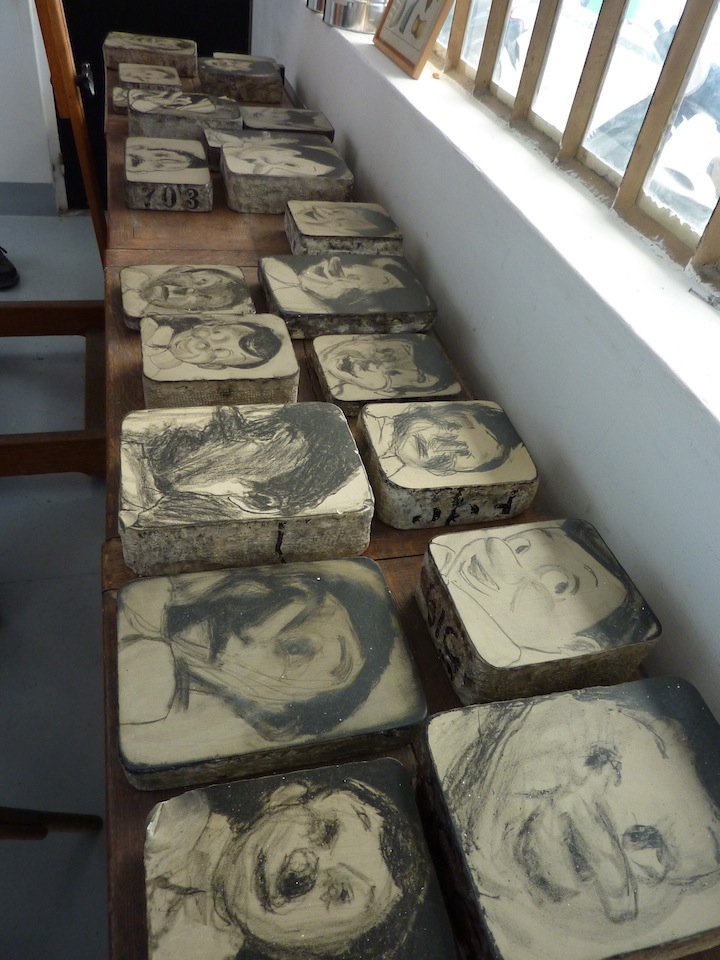
The second was also with my printmaking class. We went to visit a couple who publish their own limited editions of artists’ books. The presentation itself wasn’t that stimulating, but at the end, the husband asked if we would like to meet a printmaker from the States who kept a studio nearby. The first thing I saw when we got in was a series of stones used for lithography which had images of Pinocchio on them.


Some of the stones Jim Dine is currently using for his ongoing Pinocchio series.


It turns out they were done by Jim Dine, a huge name in printmaking and in contemporary art in general. I’d seen a show of Dine’s Pinocchio prints when I was in a tiny town in France three years ago which I’ve been raving about ever since.


A print from a show I saw in Caen 3 years ago.

It turns out that this was the very studio where Dine comes to print for several months each year and that this printmaker had arranged the show I’d seen. At the risk of over-referencing Disney movies, it really is a small world, after all.

My favorite impressive story: About a month ago, the faculty and staff got together to have a barbecue on the side of the hill on a terrace overlooking the valley. Apparently, it was a pleasant enough evening and after good food and conversation everyone adjourned for the night. Three minutes later, the entire rock retaining wall which had stood for 700 years collapsed. All that could be seen protruding from the rubble was half a patio chair. The thought of all of our faculty and staff being at best simultaneously incapacitated prompted us all to think of what it would be like for 60 U.S. students to be in another country with absolutely no supervision or guidance. There was more than Lord of the Flies reference. In all seriousness, though, if each term is allotted one miracle, this was definitely it, and we were all struck with awe regarding our surroundings, both locational and human.

My favorite chore: Laundry. I’m rarely opposed to doing laundry, but in Lacoste, I looked forward to it each week. Though there are driers available, I always chose to hang it on the line outside my house because of the stunning view.


My favorite nook in Lacoste: This is a tie. I loved my tiny room. It was a great retreat spot and despite its size, I did lots of my work there.


However, I also loved the small patio in the library which overlooks the valley. The view stunned me throughout my time in Lacoste, perhaps because the rapidly advancing spring made it look a little different everyday.


My favorite new food: As you know, I have many opinions about dairy products and I have waxed eloquent about them on many occasions. Yogurt, however, tends to be the forgotten stepchild in my dairy menagerie. Not so here. My favorite new food was apple kiwi yogurt made with sheep milk. I understand this sounds revolting. It took me a few seconds after trying it to make sure I wasn’t revolted, but once I had decided that I liked it, there was no going back. Of course, it doesn’t hurt that it comes in smooth apple green ceramic pots that fit exactly in my hands.

My favorite new art technique: I will write more about my classes later, but one exciting development for me was discovering not only a method of fixing the mud paintings that I do so that they don’t smudge, but also of combining a mud painting with line work. With a bit of experimentation, I learned that if I covered the paintings with a thin layer of methyl cellulose, a mild adhesive printmakers use for some techniques, the mud would be much more permanently attached to the paper. Once this has dried, I transfer a printout of a line drawing on top of the mud with a certain kind of blender marker. I am really excited about the result.


So as you can see, this has been an exciting term for me with lots of great discoveries, chances to learn and things to see. More soon!

Have a good week,
Sarah/Mouse