Hi Everyone,
“Once upon a time, there was a Wrghting Wrghle at Whithworth. Sarah was going to go. She was very exyed.” Thus begins one of the many stories I wrote in my second grade journal, which my parents recently unearthed. As you may be able to decipher, I have always been excited by writing. Spelling, however, is not my forte. (“But at least you knew Welsh at a very early age,” my brother said in response to my attempt at phonetic spelling.) My parents were rather puzzled at this apparent gap in my otherwise unwavering academic passion. I remember them sitting me down and telling me I really needed to work on my spelling. They toyed with the idea of setting up a reward system for improved orthographic ability and I regret to this day that I didn’t capitalize on it. But they and my teachers were patient and realized that if I just kept writing, the spelling would come. They continued to foster this interest even while I was busy penning words and phrases so obviously misspelled that they would later become part of my family’s personal argot. Rather than errpting into anger or saying they were nerves about my ability to ever write proper English, they encouraged me to work on my wrghting by journaling, making stories, and even by going to rallies at Whitworth.
The movie Doubt (Thank heavens they didn’t put me in charge of spelling that!) starring Philip Seymour Hoffman and Meryl Streep, deals brilliantly with the way doubt can be either a vehicle for discovering the truth or a sledgehammer to the truth you’ve already had. The climax of the movie comes when Meryl Streep’s character, who until that point has been adamantly suspicious of Philip Seymour Hoffman’s moral integrity, confides to her fellow sister, “I HAVE DOUBT!” In my opinion, the seriousness of the film breaks down for a moment here due to the suddenness and intensity of this revelation.
The other day, my brother and I were talking about times in our lives when we’ve been scared. My most terrifying time came after my family and I went on Semester at Sea when I was 16, when what I’d seen and learned caused me to question for the first time the religion that I’d grown up with and which structured my life. Am I Christian simply because my parents are? I wondered. Are all religions simply the opiate of the masses, as Marx said? Does Christianity deal effectively with the question of suffering? Is it even possible to know ultimate truth? This was a definite “I HAVE DOUBT!” period in my life, and I’ll be eternally grateful to the people who listened patiently to me as I processed and fretted, and I’m not even an award winning actress!
Eventually, after running my mind around in circles, it began to dawn on me that I could never argue my way back to being a Christian and that in fact, this was the whole point of faith. Since then, I have learned to see faith as an activity rather than a possession you could lose or regain. A few weeks ago, I finished President Obama’s first book, Dreams From My Father. Before he became a Christian, churchgoing friends of his would ask him about his beliefs. “I would shrug and play the question off,” he says, “unable to confess that I could no longer distinguish between faith and mere folly, between faith and simple endurance.” I love this. It acknowledges that there are times when faith has very little to do with heartfelt belief and is more about just making it through the day. It acknowledges that there are times when believing in something bigger and better than us seems to be pure idiocy.
For several years after Semester at Sea, my faith felt featherlight. I would hear a comment or learn a fact in a class that would plunge me into a nauseating spasm of doubt. This faith which I’d fought so hard to win back seemed as fickle as a windsock, inflating only when the wind was strong enough.
After some time, though, things got better. The doubts remained, to be sure, but the anxious spiritual paralysis faded away. I learned to live with doubt. Last week, I wrote the following response to the Obama quote in my journal: So often, my senses seem to be telling me that they are all there is. But I keep going, despite what my belief-o-meter is telling me on a given day. I guess that’s partly because I know by now that I’ll “come around,” that give me a few days or even hours, and I could be singing a different tune. But I think it’s also partly because by now, I tend to see those periods or moments of doubt as essential to my faith. They’re the other side of the coin, the yang, the versa, the exhale. If I don’t have voices, including my own, that are expressing doubt at least semi-regularly, my faith becomes a monologue rather than a conversation.
I now see myself as a pendulum oscillating between doubt and belief and faith is the arc that this movement creates. I think faith is as hard as spelling. I’ll never be able to spell “privilege” on the first try, and I’ll never be able to prove definitively that God exists. But there is a strength that comes from endurance and in the end, knowing the Word is more important than spelling it.
Have a good week,
Sarah/Mouse
Thursday, August 26, 2010

Wednesday, August 18, 2010
Ideally Speaking
Hello Everyone,
I’m beginning to realize how important doing laundry is to me. I’ve already written two other letters about it, and am about to start a third. But laundry is something that is by its very nature cyclical, so I don’t feel too bad about bringing it up time after time. As I mentioned in an earlier letter, when I was in France, I hung my laundry on a line to dry. This habit continued in South Africa, where even in winter, it is common to rely on good old fashioned sunshine and a nice breeze. When we got back to Spokane and started to hack away at the mountains of dirty laundry we had accumulated, it was mid-July. I was convinced that it would not only be more energy efficient to use a clothes line, it would also be quicker, since the semi-arid conditions of Spokane summers make this time of year ideal for drying clothes outside. There was one problem: we don’t have a clothes line.
Not to worry, I declared! I’m a resourceful person! So I went to our garage to see what I could use instead. I found what I deemed a worthy substitute: weed wacker cord. It was strong, we had a ton of it, and best of all, it was a lovely blue color! My brother, who by this point had taken an interest in my project, helped me tie a length of wire to a fence post. “So,” I said, “know any good knots?” We momentarily regretted that he’d never been a boy scout, where an older boy, perhaps as part of his Eagle Scout project, would perhaps have passed on some of his knotty wisdom (careful how you say that!) in a series of seminars or something. But we forged ahead and managed to tie the cord all the same. We then stretched it tight and tied the other end to a hook attached to the bottom of our deck. It was perfect! The day was roasty and the line was taught. My freshly cleaned clothes would be stretched out and dry in minutes, I was sure. Think how much energy we’d be saving by not using the drier. Maybe, I thought, with a sudden gasp of environmental evangelism, the neighbors will see our stewardship example and follow suit!
I got my basket of clothes and proudly put the first item on the line. It sagged significantly. I put the second item on and the line bent lower still. After a few more, my T-shirts were touching the ground. This was not ideal.
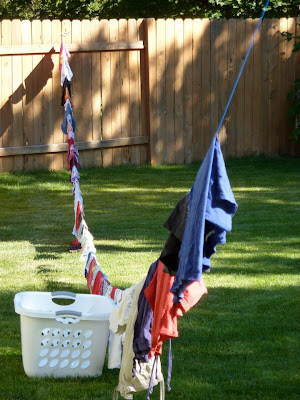
The obvious solution was to go out and buy some actual laundry line and start again. But, for whatever reason, Matthew and I continue to use this system to dry our laundry. We started propping up the loaded line with plastic lawn furniture. When the chairs got knocked over in the breeze, we used duct tape to secure them to the line. We’ve probably dried over ten loads of laundry this way, and despite the rather pathetic display in the back yard, it works!
The back yard is the arena for another operation I’ve been performing regularly. I have a backlog of dirt samples from France and South Africa that I didn’t have time to filter while I was away, so I’ve been doing that under our deck. We have a table, where I can put my growing collection of mud-filled yogurt containers. There is a spigot nearby and I can dump the refuse mud directly into the flowerbed. The only issue is that my dad and brother have been stripping the deck so they can repaint it. This means that chunks of paint have been floating down into the mud, which defeats the purpose of filtering it in the first place. So, remembering I am resourceful, I looked around until I found an old plastic table cloth which I now use to cover the mud. To ensure that it won’t blow away, I pin it down to the table with a bucket, one of my snowboots, and one of my mom’s gardening clogs.
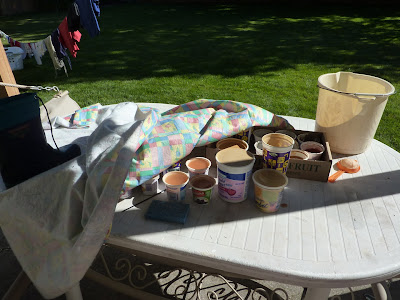

Though this seems to do the trick, I must confess that there have been several moments when I have thought to myself, “When I get a studio of my own, I won’t have to deal with these kind of inconveniences!”
But then I check myself: I paint with mud precisely because it isn’t ideal! I paint with mud because most people don’t have access to refined Winsor and Newton pigments. I paint with mud because even though I filter it, there are irregularities that make it an unpredictable and exciting medium. I paint with mud because it is inefficient, forcing me to put in hours of work before I even begin to think about an image.
I recently read a summary of the Bible which concluded by saying, “Ideally speaking, if we all lived in this kind of altruistic concern and engagement, human history would culminate in an epiphany of God in man. Mankind would visibly be ‘Christ.’” Thomas Merton, the author, put his entire summary, which was about a page long, in all caps, to separate it from the rest of the text. I read the conclusion and snort-laughed to myself. No kidding it’s “ideally speaking”! It’s hard enough for one life to be saturated with altruism, let alone all of human history. We have a very hard time seeing Christ in anyone, never mind all of humankind. However, as he said, Merton wasn’t describing what is, but what should be. Ideals are essential. They encourage us and make us aim high. They give us something to hope in and to wait for.
But it helps to recognize that sometimes, “good enough” is precisely that. We don’t live in the ideal; we live in the dirt. And as long as we manage to clean our clothes every so often, who cares how exactly we dry them?
Have a good week,
Sarah/Mouse
I’m beginning to realize how important doing laundry is to me. I’ve already written two other letters about it, and am about to start a third. But laundry is something that is by its very nature cyclical, so I don’t feel too bad about bringing it up time after time. As I mentioned in an earlier letter, when I was in France, I hung my laundry on a line to dry. This habit continued in South Africa, where even in winter, it is common to rely on good old fashioned sunshine and a nice breeze. When we got back to Spokane and started to hack away at the mountains of dirty laundry we had accumulated, it was mid-July. I was convinced that it would not only be more energy efficient to use a clothes line, it would also be quicker, since the semi-arid conditions of Spokane summers make this time of year ideal for drying clothes outside. There was one problem: we don’t have a clothes line.
Not to worry, I declared! I’m a resourceful person! So I went to our garage to see what I could use instead. I found what I deemed a worthy substitute: weed wacker cord. It was strong, we had a ton of it, and best of all, it was a lovely blue color! My brother, who by this point had taken an interest in my project, helped me tie a length of wire to a fence post. “So,” I said, “know any good knots?” We momentarily regretted that he’d never been a boy scout, where an older boy, perhaps as part of his Eagle Scout project, would perhaps have passed on some of his knotty wisdom (careful how you say that!) in a series of seminars or something. But we forged ahead and managed to tie the cord all the same. We then stretched it tight and tied the other end to a hook attached to the bottom of our deck. It was perfect! The day was roasty and the line was taught. My freshly cleaned clothes would be stretched out and dry in minutes, I was sure. Think how much energy we’d be saving by not using the drier. Maybe, I thought, with a sudden gasp of environmental evangelism, the neighbors will see our stewardship example and follow suit!
I got my basket of clothes and proudly put the first item on the line. It sagged significantly. I put the second item on and the line bent lower still. After a few more, my T-shirts were touching the ground. This was not ideal.

The obvious solution was to go out and buy some actual laundry line and start again. But, for whatever reason, Matthew and I continue to use this system to dry our laundry. We started propping up the loaded line with plastic lawn furniture. When the chairs got knocked over in the breeze, we used duct tape to secure them to the line. We’ve probably dried over ten loads of laundry this way, and despite the rather pathetic display in the back yard, it works!
The back yard is the arena for another operation I’ve been performing regularly. I have a backlog of dirt samples from France and South Africa that I didn’t have time to filter while I was away, so I’ve been doing that under our deck. We have a table, where I can put my growing collection of mud-filled yogurt containers. There is a spigot nearby and I can dump the refuse mud directly into the flowerbed. The only issue is that my dad and brother have been stripping the deck so they can repaint it. This means that chunks of paint have been floating down into the mud, which defeats the purpose of filtering it in the first place. So, remembering I am resourceful, I looked around until I found an old plastic table cloth which I now use to cover the mud. To ensure that it won’t blow away, I pin it down to the table with a bucket, one of my snowboots, and one of my mom’s gardening clogs.


Though this seems to do the trick, I must confess that there have been several moments when I have thought to myself, “When I get a studio of my own, I won’t have to deal with these kind of inconveniences!”
But then I check myself: I paint with mud precisely because it isn’t ideal! I paint with mud because most people don’t have access to refined Winsor and Newton pigments. I paint with mud because even though I filter it, there are irregularities that make it an unpredictable and exciting medium. I paint with mud because it is inefficient, forcing me to put in hours of work before I even begin to think about an image.
I recently read a summary of the Bible which concluded by saying, “Ideally speaking, if we all lived in this kind of altruistic concern and engagement, human history would culminate in an epiphany of God in man. Mankind would visibly be ‘Christ.’” Thomas Merton, the author, put his entire summary, which was about a page long, in all caps, to separate it from the rest of the text. I read the conclusion and snort-laughed to myself. No kidding it’s “ideally speaking”! It’s hard enough for one life to be saturated with altruism, let alone all of human history. We have a very hard time seeing Christ in anyone, never mind all of humankind. However, as he said, Merton wasn’t describing what is, but what should be. Ideals are essential. They encourage us and make us aim high. They give us something to hope in and to wait for.
But it helps to recognize that sometimes, “good enough” is precisely that. We don’t live in the ideal; we live in the dirt. And as long as we manage to clean our clothes every so often, who cares how exactly we dry them?
Have a good week,
Sarah/Mouse
Tuesday, August 10, 2010
Voice
Hello Everyone,
A few weeks ago, my family celebrated my parents’ 30th wedding anniversary partly by listening to a cassette recording of the speeches made at their reception. The best man spoke first, offering encouragement and congratulations. My uncle spoke next, seeing the occasion as a chance not only to offer wisdom and his best wishes, but also to share some of his favorite jokes regardless of whether he could think of an appropriate segue. Then it was time for the speech my brother and I had been waiting a lifetime to hear. Ever since I can remember, people have been telling me what a good speech my dad gave. “A classic,” they’d say. “I will remember it for the rest of my life.”
So we were ready to be amazed, and amazed we certainly were. A man with a rather high pitched and vaguely sibilant voice started talking and Matthew and I assumed he was introducing our father. It took us about a minute of context clues and assurance from our parents to realize that it was our father. It was a great speech, but though the content was quintessential Daddy with a sustained comic theme, a hilarious impression of the then president of South Africa, P.W. Botha, and a brilliantly placed pun to cap it all off, the voice was incongruous. He proceeded to speak this way for maybe ten minutes. His intonation and inflection were the same, but that voice! We thought maybe the tape had warped after three decades, but the other two speakers had sounded normal. There was only one explanation: his voice has changed significantly.
This incident threw into turmoil an analogy I adopted several years ago to help me understand the difference between artistic “style” and “voice.” I heard from an illustrator that one’s style is more superficial or at least more controllable than one’s voice. Just as you can change fashion styles by putting on a different set of clothes, you can change artistic styles by choosing to draw differently, for example by including significantly more or less detail, by using a very different medium, or by relying more or less on value or textures. I think that accents are the vocal equivalent of style. My brother can change between accents faster than an experienced shopaholic goes through outfits in the Nordstrom changing rooms on Black Friday. Even people who aren’t training to be actors sometimes find themselves involuntarily imitating those exotic foreigners who pronounce “been” as “bean,” and who say things like “I need to go to the loo.”
One’s voice, though, is much harder to change. We think that essentially once we’ve braved our way through the murky waters of puberty, our voices remain relatively constant. I had a childhood friend who was always trying to make her voice less nasal. And though her attempts provided me many a good laugh, she never succeeded in modifying her voice at all. And perhaps because of this apparent permanence, it seems that people sometimes listen more to our voices than to our accents or even to the words we say. Although my mom’s accent has softened a bit and mine has always been slightly more British-sounding than my peers’, we have distinctly different accents. And yet I can’t count the number of times I answer the phone by saying, “Hi, this is Sarah,” only to have the person on the other end respond by saying, “Hi Sue, this is so-and-so.” It gets confusing when they ask for me:
“Oh hi, Carrie. Actually, this is Sarah.”
“How are you doing? Are you having a good summer?”
“Yeah, it’s been good. You?”
“Very good, thank you. Well, could you tell Sarah that she needs to set up an appointment at the dentist?”
“Um . . . well, this IS Sarah.”
“She could come in any time next week.”
“Uh . . . actually, this is -- oh nevermind. Yeah, I’ll have her call you back.”
So it was all the more strange to me that it was my dad’s voice -- not just his accent -- that had changed so dramatically. The analogy the illustrator had given me was in danger of either exploding or expanding. If my physical voice doesn’t remain constant throughout life, does that meant that my artistic voice will also change? Of course, I want to grow and develop, but shouldn’t there be a definitive Mouse-ish-ness to all my work? I don’t know, and I don’t suppose it is terribly helpful or healthy to be constantly examining my work wondering, “Is this drawing the real me? . . . What about this one?” So many things are better understood in retrospect.
Some voices do change over time, and so they should. They subconsciously react to new experiences and other people’s voices. Come to think of it, this sounds a lot like the job description of an artist. The past thirty years have been incredibly rich for my parents, and if the next thirty are similarly varied, who knows what my dad will sound like in 2040!
Have a good week,
Sarah/Mouse
A few weeks ago, my family celebrated my parents’ 30th wedding anniversary partly by listening to a cassette recording of the speeches made at their reception. The best man spoke first, offering encouragement and congratulations. My uncle spoke next, seeing the occasion as a chance not only to offer wisdom and his best wishes, but also to share some of his favorite jokes regardless of whether he could think of an appropriate segue. Then it was time for the speech my brother and I had been waiting a lifetime to hear. Ever since I can remember, people have been telling me what a good speech my dad gave. “A classic,” they’d say. “I will remember it for the rest of my life.”
So we were ready to be amazed, and amazed we certainly were. A man with a rather high pitched and vaguely sibilant voice started talking and Matthew and I assumed he was introducing our father. It took us about a minute of context clues and assurance from our parents to realize that it was our father. It was a great speech, but though the content was quintessential Daddy with a sustained comic theme, a hilarious impression of the then president of South Africa, P.W. Botha, and a brilliantly placed pun to cap it all off, the voice was incongruous. He proceeded to speak this way for maybe ten minutes. His intonation and inflection were the same, but that voice! We thought maybe the tape had warped after three decades, but the other two speakers had sounded normal. There was only one explanation: his voice has changed significantly.
This incident threw into turmoil an analogy I adopted several years ago to help me understand the difference between artistic “style” and “voice.” I heard from an illustrator that one’s style is more superficial or at least more controllable than one’s voice. Just as you can change fashion styles by putting on a different set of clothes, you can change artistic styles by choosing to draw differently, for example by including significantly more or less detail, by using a very different medium, or by relying more or less on value or textures. I think that accents are the vocal equivalent of style. My brother can change between accents faster than an experienced shopaholic goes through outfits in the Nordstrom changing rooms on Black Friday. Even people who aren’t training to be actors sometimes find themselves involuntarily imitating those exotic foreigners who pronounce “been” as “bean,” and who say things like “I need to go to the loo.”
One’s voice, though, is much harder to change. We think that essentially once we’ve braved our way through the murky waters of puberty, our voices remain relatively constant. I had a childhood friend who was always trying to make her voice less nasal. And though her attempts provided me many a good laugh, she never succeeded in modifying her voice at all. And perhaps because of this apparent permanence, it seems that people sometimes listen more to our voices than to our accents or even to the words we say. Although my mom’s accent has softened a bit and mine has always been slightly more British-sounding than my peers’, we have distinctly different accents. And yet I can’t count the number of times I answer the phone by saying, “Hi, this is Sarah,” only to have the person on the other end respond by saying, “Hi Sue, this is so-and-so.” It gets confusing when they ask for me:
“Oh hi, Carrie. Actually, this is Sarah.”
“How are you doing? Are you having a good summer?”
“Yeah, it’s been good. You?”
“Very good, thank you. Well, could you tell Sarah that she needs to set up an appointment at the dentist?”
“Um . . . well, this IS Sarah.”
“She could come in any time next week.”
“Uh . . . actually, this is -- oh nevermind. Yeah, I’ll have her call you back.”
So it was all the more strange to me that it was my dad’s voice -- not just his accent -- that had changed so dramatically. The analogy the illustrator had given me was in danger of either exploding or expanding. If my physical voice doesn’t remain constant throughout life, does that meant that my artistic voice will also change? Of course, I want to grow and develop, but shouldn’t there be a definitive Mouse-ish-ness to all my work? I don’t know, and I don’t suppose it is terribly helpful or healthy to be constantly examining my work wondering, “Is this drawing the real me? . . . What about this one?” So many things are better understood in retrospect.
Some voices do change over time, and so they should. They subconsciously react to new experiences and other people’s voices. Come to think of it, this sounds a lot like the job description of an artist. The past thirty years have been incredibly rich for my parents, and if the next thirty are similarly varied, who knows what my dad will sound like in 2040!
Have a good week,
Sarah/Mouse
Tuesday, July 20, 2010
Chocolate, Wine and All That's Fine!
Hello Everyone,
One of the interesting aspects of being in South Africa with my family again is that it is a familiar but not completely regular event in our lives. As such, it has been a chance for us and our friends and family to measure how we’ve changed. Some people noticed, for instance, that my dad no longer wears his glasses after his cataract surgery, while my mom sported hers briefly after a contact-losing incident in Grahamstown. My brother was by far the biggest shock to everyone we met and once people located his torso and head poking through the hole in the ozone layer, they usually let forth some kind of exclamation like, “My heavens!” or “What happened to you?” I’ve been wondering that for years.
As someone whose upward growth terminated in the last millennium, I am perhaps more acutely aware of less physical changes. I’m beginning to conclude that part of growing up is learning to like things you once detested with every fiber of your being. I don’t know if age chisels away our once-adamant standards or if it simply provides the wisdom to increase our tolerance in certain areas, but humans universally reserve the right to change their opinions as they grow older.
This time in South Africa, I’ve been noticing that I have actually acquired many tastes which I once regarded as being reserved for idiotic adults. When I was younger, for example, I couldn’t imagine who in their right mind would ever invent dark chocolate. Nor could I imagine that once it was invented, someone might actually choose it over milk chocolate. Wine also fell into this category. So you take grape juice, and you let it rot a bit so it gets bitter, and then you drink it? No wonder Peter Pan never wanted to grow up.
Another thing I associated with being old was liking birds and plants. When we went to zoos or game reserves when I was younger, I couldn’t understand why the grownups spent so much time getting excited about birds. Sure, they were sometimes colorful and made interesting noises, but next to
 an elephant,
 or a rhino,
 or a giraffe,
-- I mean, really! -- no comparison! And plants were worse -- they don’t even move! My grandmother loved both and I suspect I transferred her passion to more adults than was fair, but in my eight-year-old mind, I’d know I was old when I started wearing floral print blouses and having long chats with sparrows in the backyard.
I assumed that learning to like dark chocolate and wine and other disgusting things were thresholds I would have to cross as I forged into adulthood. I pictured one of those evolution of man cartoons where the monkey on all fours is crawling along, eating sensible things like graham crackers and root beer (when his mommy would let him); the more adept and upright monkey next to him is able to do his homework on his own; the one next to that one has figured out how to make a friend or two in middle school; the next has gotten his driver’s license; the next has graduated from high school; the almost-humanoid is in college and finally (ta-da!), the recognizable adult human is walking erectly, trimming hedges while sipping wine, eating dark chocolate and using words like “mortgage,” “diesel engine,” and “APR financing.”
However, as I mentioned, this trip has been showing me that I’m further along in the Darwinian diagram than I thought. We’ve been going to wine estates and I certainly appreciate the reputation South African wine has. Many of you know how essential chocolate is in a Jackson family trip, and several of the chocolates we’ve gotten have been of the dark variety. Some of my favorite photos from this trip have been of plants and birds.
 Some kind of wizened-looking ibis.
 Aloe leaves.
 A wildebeest behind some shrubs.
 A Milky Giant Eagle Owl we saw at a bird sanctuary.
 Scoping out the waterhole.
 A guinea fowl: "Oh no, you di-ent!"
 A kingfisher in flight.
 Some grass in the sunset.
 A spoonbill landing at a waterhole.
I think spoonbills get the prize for the strangest looking birds we saw this trip.
 Some birds coming in to land at the waterhole.
By my childhood definition, I am essentially a full-fledged adult now. I not only tolerate some things I used to hate -- I really enjoy them! And to my surprise, I don’t feel a huge loss of innocence; the chocolate may be dark, but adulthood doesn’t have to be.
Of course, there is not usually any rhyme or reason to what starts to tempt us and what continues to repulse us. When I was younger, I hated rice, any cooked vegetables and fish (God must have known that I would have withered away if he’d given me to Asian parents). About four years ago, I learned to like rice. I was sitting at an Iranian restaurant in Seattle with my friends and the only vegetarian option on the menu was some kind of rice dish. I sighed internally and knew I’d just have to grin and bear it. To my utmost surprise, I found that I not only could stomach the rice -- I was actually enjoying it quite a lot. Rice has now become one of my favorite foods and a staple in my diet. Cooked veggies likewise have become much more appetizing to me, though I still generally prefer them raw or frozen. Fish, on the other hand, has fallen even further in my taste buds’ estimation, perhaps because I now don’t eat any meat.
I can’t explain how I convinced myself that rice was delicious or how I went from cringing at a real wine Eucharist offered in some churches to cringing at the grape juice offered at others (I suppose it’s not entirely inappropriate to squirm during Communion). Some parts of growing up just come naturally like learning to walk or losing your teeth, and I guess liking dark chocolate must be one of them. Other parts need to be drilled repeatedly into your head and are much more difficult to get: time management, loving your neighbor as yourself, keeping your room tidy, whistling.
My family and I are safe at home in Spokane now after a freakishly long time in transit. I’m looking forward to seeing or talking with many of you soon, after I sleep some more, and I’m grateful to have seen others of you so recently!
Have a good week,
Sarah/Mouse
One of the interesting aspects of being in South Africa with my family again is that it is a familiar but not completely regular event in our lives. As such, it has been a chance for us and our friends and family to measure how we’ve changed. Some people noticed, for instance, that my dad no longer wears his glasses after his cataract surgery, while my mom sported hers briefly after a contact-losing incident in Grahamstown. My brother was by far the biggest shock to everyone we met and once people located his torso and head poking through the hole in the ozone layer, they usually let forth some kind of exclamation like, “My heavens!” or “What happened to you?” I’ve been wondering that for years.
As someone whose upward growth terminated in the last millennium, I am perhaps more acutely aware of less physical changes. I’m beginning to conclude that part of growing up is learning to like things you once detested with every fiber of your being. I don’t know if age chisels away our once-adamant standards or if it simply provides the wisdom to increase our tolerance in certain areas, but humans universally reserve the right to change their opinions as they grow older.
This time in South Africa, I’ve been noticing that I have actually acquired many tastes which I once regarded as being reserved for idiotic adults. When I was younger, for example, I couldn’t imagine who in their right mind would ever invent dark chocolate. Nor could I imagine that once it was invented, someone might actually choose it over milk chocolate. Wine also fell into this category. So you take grape juice, and you let it rot a bit so it gets bitter, and then you drink it? No wonder Peter Pan never wanted to grow up.
Another thing I associated with being old was liking birds and plants. When we went to zoos or game reserves when I was younger, I couldn’t understand why the grownups spent so much time getting excited about birds. Sure, they were sometimes colorful and made interesting noises, but next to
 an elephant,
 or a rhino,
 or a giraffe,
-- I mean, really! -- no comparison! And plants were worse -- they don’t even move! My grandmother loved both and I suspect I transferred her passion to more adults than was fair, but in my eight-year-old mind, I’d know I was old when I started wearing floral print blouses and having long chats with sparrows in the backyard.
I assumed that learning to like dark chocolate and wine and other disgusting things were thresholds I would have to cross as I forged into adulthood. I pictured one of those evolution of man cartoons where the monkey on all fours is crawling along, eating sensible things like graham crackers and root beer (when his mommy would let him); the more adept and upright monkey next to him is able to do his homework on his own; the one next to that one has figured out how to make a friend or two in middle school; the next has gotten his driver’s license; the next has graduated from high school; the almost-humanoid is in college and finally (ta-da!), the recognizable adult human is walking erectly, trimming hedges while sipping wine, eating dark chocolate and using words like “mortgage,” “diesel engine,” and “APR financing.”
However, as I mentioned, this trip has been showing me that I’m further along in the Darwinian diagram than I thought. We’ve been going to wine estates and I certainly appreciate the reputation South African wine has. Many of you know how essential chocolate is in a Jackson family trip, and several of the chocolates we’ve gotten have been of the dark variety. Some of my favorite photos from this trip have been of plants and birds.
 Some kind of wizened-looking ibis.
 Aloe leaves.
 A wildebeest behind some shrubs.
 A Milky Giant Eagle Owl we saw at a bird sanctuary.
 Scoping out the waterhole.
 A guinea fowl: "Oh no, you di-ent!"
 A kingfisher in flight.
 Some grass in the sunset.
 A spoonbill landing at a waterhole.
I think spoonbills get the prize for the strangest looking birds we saw this trip.
 Some birds coming in to land at the waterhole.
By my childhood definition, I am essentially a full-fledged adult now. I not only tolerate some things I used to hate -- I really enjoy them! And to my surprise, I don’t feel a huge loss of innocence; the chocolate may be dark, but adulthood doesn’t have to be.
Of course, there is not usually any rhyme or reason to what starts to tempt us and what continues to repulse us. When I was younger, I hated rice, any cooked vegetables and fish (God must have known that I would have withered away if he’d given me to Asian parents). About four years ago, I learned to like rice. I was sitting at an Iranian restaurant in Seattle with my friends and the only vegetarian option on the menu was some kind of rice dish. I sighed internally and knew I’d just have to grin and bear it. To my utmost surprise, I found that I not only could stomach the rice -- I was actually enjoying it quite a lot. Rice has now become one of my favorite foods and a staple in my diet. Cooked veggies likewise have become much more appetizing to me, though I still generally prefer them raw or frozen. Fish, on the other hand, has fallen even further in my taste buds’ estimation, perhaps because I now don’t eat any meat.
I can’t explain how I convinced myself that rice was delicious or how I went from cringing at a real wine Eucharist offered in some churches to cringing at the grape juice offered at others (I suppose it’s not entirely inappropriate to squirm during Communion). Some parts of growing up just come naturally like learning to walk or losing your teeth, and I guess liking dark chocolate must be one of them. Other parts need to be drilled repeatedly into your head and are much more difficult to get: time management, loving your neighbor as yourself, keeping your room tidy, whistling.
My family and I are safe at home in Spokane now after a freakishly long time in transit. I’m looking forward to seeing or talking with many of you soon, after I sleep some more, and I’m grateful to have seen others of you so recently!
Have a good week,
Sarah/Mouse
Wednesday, July 7, 2010
The Vuvuzela Gees
Hello Everyone,
When I arrived in Johannesburg a month ago, someone asked me if I could feel the gees (an Afrikaans word rhyming with “see us” and pronounced using 12 muscles in the back of your throat). I quickly learned that gees means “spirit” and in this case, referred to the nationwide atmosphere that is accompanying the World Cup festivities. To be honest, I am usually not a gung-ho participant in spirit-oriented activities. My least favorite event in high school after prom was Spirit Week because I found it so stressful to think of creative outfits to wear. Couldn’t we forget all this nonsense and just get on with our learning? (I have since learned how to have fun which I’m sure has been a significant relief to most people around me.)
The spirit here, however, seems a bit different. People are comparing it to the elections in 1994 or the Rugby World Cup in 1995, which the movie Invictus dramatized. In the Apartheid Museum in Johannesburg, we were told that under the old government, one way to tell what race a man was by the sport he played. White people played rugby; black people played soccer. The Springboks (the national rugby team) was white; Bafana Bafana (the national soccer team) was black. The two teams are still mostly divided along racial lines, but it is a sign of how far this country has come to see how uniformly South Africans participate in the excitement surrounding the tournament. Everyone, it seems, has some kind of Bafana Bafana paraphernalia. Black and white take a back seat to green and gold.

A parade my mom saw in the days leading up to the World Cup.
 On the corner of every street in Johannesburg, it seems,
there is someone wanting to sell you flags.
 First Day of the World Cup: workers taking a break to play Foosball
in the Rosebank Mall in Johannesburg.
 These folks seem to be supporting everyone!
 Xolisa displays the gees.
Everyone talks about it. People who have never watched a soccer game in their life are finding themselves shrieking at their TV screens in fits of unbridled passion. The World Cup has replaced the weather as the natural, neutral conversation starter, and mentioning it has even gotten a few folks we know out of traffic violation fines.
The 2010 World Cup will probably be remembered for some surprising results -- already football giants like Brazil, England, France, Argentina have been sent home. But without a doubt, South Africa will be known for being the host country to introduce the world to the vuvuzela. For those of you who may not be familiar with this instrument, it is a slender horn, usually made from colorful plastic which you play after your team has scored a goal, or if your team hasn’t scored in a while, or if your team qualified for the World Cup, or even if you happen to be thinking about soccer at all. It is essentially a kazoo on steroids. If you have been watching any of the matches on TV, you would have heard a perpetual buzzing noise coming from the crowd. This isn’t angry African hornets, but swarms of congregating vuvuzela players. Individual vuvuzelas sound like wild geese tuning up at a middle school band concert. It is not the most melodic of instruments, but more than anything else, it has come to exemplify and relate the South African gees to the world. What’s more, they have taken off elsewhere and have become so popular that the officials at Wimbledon preemptively banned them this year.
 From the stadium in Johannesburg . . .

. . . to the garbage dumps of Mthatha . . .
 . . . everyone loves the vuvuzela!
 A young Bafana Bafana fan wearing what have been dubbed "shushuzelas" in his ears.
Of course, South Africans played their vuvuzelas most excitedly during the matches in which Bafana Bafana played. South Africa scored the first goal of the tournament to tie their match with Mexico. In their match against Uruguay, they lost 0-3 due to some unfair refereeing and a lot poor playing on their part. Because of the significant goal differential from this game, the chances were very low that they could make it to the second round. Everything depended on their match with France and the outcome of the Mexico-Uruguay match. I was listening to both matches on the radio of a bus on my way to Grahamstown. Bafana Bafana scored quite quickly and everyone perked up. France seemed in disarray and soon one of their players got a red card. Things were looking up. When they scored their second goal, the entire bus erupted in cheers. We were just pulling into East London and there was an enormous full rainbow stretching over the city. It was cliché and perfect -- the Rainbow Nation’s hopes were sailing. If we could get two goals in the first half, there was a chance we could get enough to make it through to the next round. As we came into the city, people came out onto the sidewalks to waive and blow their vuvuzelas at us.
The sun was setting as we pulled out of East London and the second half began. France ended up scoring and the game ended in a Bafana win 2-1. This wasn’t enough to move onto the next round, but it was a good way to end the tournament, especially since France has been such a formidable team in the past. Of course, people were disappointed, but in general, the attitude seemed to be that Bafana Bafana did better than anyone expected them to and that’s good enough. As we get further from the initial round, the first and especially the final match South African played morph from news reports into legends and begin to take their place alongside the other stories this country tells itself.
People are divided about what the World Cup is doing to South Africa. Some folks are upset that so much money and energy can be put into something so temporary. If the government can get its act together and show off to the world for one month, surely they could work with similar vigor to battle the ever-present demons in the departments of education, healthcare and the environment? To a large extent, I agree. If I had to choose between quality education for the country’s primary schoolchildren or a well run soccer tournament, of course I would choose the former. I’m sure most sane people would.
And yet, nobody ever has all of their ducks in a row. I doubt that if South Africa had been denied the World Cup, people would have collectively said, “Well, with the extra time, energy, and resources, why don’t we tackle, say, the HIV/AIDS problem in this country?” I’m beginning to conclude that South Africans run their country the way that Bafana Bafana plays soccer: in fits and starts. Sometimes they fail miserably. Sometimes they defy our wildest expectations. You could never call them average, but on average, they do alright. I’ll leave it to wiser minds to decide whether that is good enough.
A few days ago, my family and I visited an older woman who we first met 20 years ago. Since we last saw her, she has had a stroke and has developed epilepsy. She must have round-the-clock care and can’t do even the simplest tasks without help. She told us that one blessing that has come as a result of the stroke is that she now has time to sit, think, pray and reminisce. She said she is more at peace than she ever has been. This lady reminded me of how important memories are in maintaining relationships and in continuing to hope. Yes, it’s unhealthy to live in the past, but it can sustain you when the present seems unable to.
Every so often, there is an event that unites an entire country. In the U.S. the only time I have experienced this was on and after September 11th, 2001. For better or for worse, people in S. A. still depend on memories of the democratic elections in 1994 as a source of strength and unity. A few years from now, when the knock-off green and gold jerseys have begun to fray at the edges and when what are now glistening new stadiums have begun to age, people will be left with stories of Tshabala’s gorgeous goals or the nationwide outrage against Khune’s (completely unmerited and idiotically-inspired) red card. People will still talk about crowding into fan parks or a friend’s living room to watch the matches. Such stories will reignite the gees which is currently uniting South Africa and for that alone, I think the World Cup is worth it.
At the very least, it’s given South Africans vuvuzela players a worldwide stage on which to perform!

Have a good week,
Sarah/Mouse
When I arrived in Johannesburg a month ago, someone asked me if I could feel the gees (an Afrikaans word rhyming with “see us” and pronounced using 12 muscles in the back of your throat). I quickly learned that gees means “spirit” and in this case, referred to the nationwide atmosphere that is accompanying the World Cup festivities. To be honest, I am usually not a gung-ho participant in spirit-oriented activities. My least favorite event in high school after prom was Spirit Week because I found it so stressful to think of creative outfits to wear. Couldn’t we forget all this nonsense and just get on with our learning? (I have since learned how to have fun which I’m sure has been a significant relief to most people around me.)
The spirit here, however, seems a bit different. People are comparing it to the elections in 1994 or the Rugby World Cup in 1995, which the movie Invictus dramatized. In the Apartheid Museum in Johannesburg, we were told that under the old government, one way to tell what race a man was by the sport he played. White people played rugby; black people played soccer. The Springboks (the national rugby team) was white; Bafana Bafana (the national soccer team) was black. The two teams are still mostly divided along racial lines, but it is a sign of how far this country has come to see how uniformly South Africans participate in the excitement surrounding the tournament. Everyone, it seems, has some kind of Bafana Bafana paraphernalia. Black and white take a back seat to green and gold.

A parade my mom saw in the days leading up to the World Cup.
 On the corner of every street in Johannesburg, it seems,
there is someone wanting to sell you flags.
 First Day of the World Cup: workers taking a break to play Foosball
in the Rosebank Mall in Johannesburg.
 These folks seem to be supporting everyone!
 Xolisa displays the gees.
Everyone talks about it. People who have never watched a soccer game in their life are finding themselves shrieking at their TV screens in fits of unbridled passion. The World Cup has replaced the weather as the natural, neutral conversation starter, and mentioning it has even gotten a few folks we know out of traffic violation fines.
The 2010 World Cup will probably be remembered for some surprising results -- already football giants like Brazil, England, France, Argentina have been sent home. But without a doubt, South Africa will be known for being the host country to introduce the world to the vuvuzela. For those of you who may not be familiar with this instrument, it is a slender horn, usually made from colorful plastic which you play after your team has scored a goal, or if your team hasn’t scored in a while, or if your team qualified for the World Cup, or even if you happen to be thinking about soccer at all. It is essentially a kazoo on steroids. If you have been watching any of the matches on TV, you would have heard a perpetual buzzing noise coming from the crowd. This isn’t angry African hornets, but swarms of congregating vuvuzela players. Individual vuvuzelas sound like wild geese tuning up at a middle school band concert. It is not the most melodic of instruments, but more than anything else, it has come to exemplify and relate the South African gees to the world. What’s more, they have taken off elsewhere and have become so popular that the officials at Wimbledon preemptively banned them this year.
 From the stadium in Johannesburg . . .
. . . to the garbage dumps of Mthatha . . .
 . . . everyone loves the vuvuzela!
 A young Bafana Bafana fan wearing what have been dubbed "shushuzelas" in his ears.
Of course, South Africans played their vuvuzelas most excitedly during the matches in which Bafana Bafana played. South Africa scored the first goal of the tournament to tie their match with Mexico. In their match against Uruguay, they lost 0-3 due to some unfair refereeing and a lot poor playing on their part. Because of the significant goal differential from this game, the chances were very low that they could make it to the second round. Everything depended on their match with France and the outcome of the Mexico-Uruguay match. I was listening to both matches on the radio of a bus on my way to Grahamstown. Bafana Bafana scored quite quickly and everyone perked up. France seemed in disarray and soon one of their players got a red card. Things were looking up. When they scored their second goal, the entire bus erupted in cheers. We were just pulling into East London and there was an enormous full rainbow stretching over the city. It was cliché and perfect -- the Rainbow Nation’s hopes were sailing. If we could get two goals in the first half, there was a chance we could get enough to make it through to the next round. As we came into the city, people came out onto the sidewalks to waive and blow their vuvuzelas at us.
The sun was setting as we pulled out of East London and the second half began. France ended up scoring and the game ended in a Bafana win 2-1. This wasn’t enough to move onto the next round, but it was a good way to end the tournament, especially since France has been such a formidable team in the past. Of course, people were disappointed, but in general, the attitude seemed to be that Bafana Bafana did better than anyone expected them to and that’s good enough. As we get further from the initial round, the first and especially the final match South African played morph from news reports into legends and begin to take their place alongside the other stories this country tells itself.
People are divided about what the World Cup is doing to South Africa. Some folks are upset that so much money and energy can be put into something so temporary. If the government can get its act together and show off to the world for one month, surely they could work with similar vigor to battle the ever-present demons in the departments of education, healthcare and the environment? To a large extent, I agree. If I had to choose between quality education for the country’s primary schoolchildren or a well run soccer tournament, of course I would choose the former. I’m sure most sane people would.
And yet, nobody ever has all of their ducks in a row. I doubt that if South Africa had been denied the World Cup, people would have collectively said, “Well, with the extra time, energy, and resources, why don’t we tackle, say, the HIV/AIDS problem in this country?” I’m beginning to conclude that South Africans run their country the way that Bafana Bafana plays soccer: in fits and starts. Sometimes they fail miserably. Sometimes they defy our wildest expectations. You could never call them average, but on average, they do alright. I’ll leave it to wiser minds to decide whether that is good enough.
A few days ago, my family and I visited an older woman who we first met 20 years ago. Since we last saw her, she has had a stroke and has developed epilepsy. She must have round-the-clock care and can’t do even the simplest tasks without help. She told us that one blessing that has come as a result of the stroke is that she now has time to sit, think, pray and reminisce. She said she is more at peace than she ever has been. This lady reminded me of how important memories are in maintaining relationships and in continuing to hope. Yes, it’s unhealthy to live in the past, but it can sustain you when the present seems unable to.
Every so often, there is an event that unites an entire country. In the U.S. the only time I have experienced this was on and after September 11th, 2001. For better or for worse, people in S. A. still depend on memories of the democratic elections in 1994 as a source of strength and unity. A few years from now, when the knock-off green and gold jerseys have begun to fray at the edges and when what are now glistening new stadiums have begun to age, people will be left with stories of Tshabala’s gorgeous goals or the nationwide outrage against Khune’s (completely unmerited and idiotically-inspired) red card. People will still talk about crowding into fan parks or a friend’s living room to watch the matches. Such stories will reignite the gees which is currently uniting South Africa and for that alone, I think the World Cup is worth it.
At the very least, it’s given South Africans vuvuzela players a worldwide stage on which to perform!

Have a good week,
Sarah/Mouse
Saturday, June 19, 2010
Kid Version -- Pilgrim
Hi guys!
I’d like to tell you about a trip I took a few weeks ago with a few of my friends. It was different from most of the other trips I’ve taken because it was a pilgrimage. You may have studied the Pilgrims in school. They were a group of people who wore funny hats and left England in the 1600s and came to what later became Massachusetts. The ship they sailed on became famous. Do you know what its name was?
Well, I didn’t sail to Massachusetts and I didn’t wear a funny hat, but on this trip, I became a pilgrim for a week. You’re a pilgrim when you go on a long journey to a place that is important to you. The journey is called a pilgrimage, and it is usually as exciting as actually getting to where you want to end up.
Four years ago, my friends Jasmine and Amanda and I went to a country in Europe called Spain. We spent a week walking on a trail called the Camino de Santiago. It’s very long and it ends in a city in western Spain called Santiago de Compostela. For hundreds of years, pilgrims have been traveling there to visit a cathedral that is important to lots of Christians. Jasmine, Amanda and I aren’t as interested in seeing the cathedral -- we’re more excited about all the places we get to see on the way there! The pilgrimage takes about two months if you walk the whole thing, and we had enough time to do only the first part, but we decided we’d come back and finish. A few weeks ago, Jasmine, Amanda and I all met in Spain where we’d stopped walking four years ago and we walked for another week or so along the Camino.
You might be thinking, Sarah Jackson, if you don’t care much about this city, why would you spend so much time walking toward it? Good question. There are lots of reasons why people make a pilgrimage, and the ending point, or destination, is only one of them. Here are some other reasons why we wanted to be pilgrims:
You get to meet new people: We weren’t the only pilgrims on the trail and along the way, we got to meet people of all different ages from places like Puerto Rico, Austria and Belgium. Do you know anyone from another country? Where is he or she from? We also got to meet Spanish people (and animals!) who lived in the towns we visited.
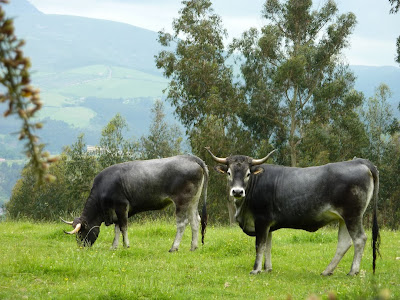
Everyone we met was kind and wanted to help us if they could. They would show us how to get to the trail or would give us water. Can you remember a time when someone helped you?
 We had to follow yellow arrows to know where the path was, but when we couldn't find any arrows, we got lost and had to ask people for help.
You get to see cool new things: Anytime you go somewhere, if you keep your eyes open, you will see something amazing that you’ve never seen before.
 On this trip, I saw some flowers that looked kind of like bright red hedgehogs.
 I also saw a thin line of light on the horizon.
What amazing things have you seen recently?
You get to see beautiful places: Northern Spain, where we were hiking, is one of the loveliest places I’ve ever seen. We were in big cities and tiny towns, in the mountains and along the beach.

A beautiful beach.
 A beautiful valley.
 A beautiful harbor.
 A beautiful rock in a beautiful ocean.
 A beautiful town.
 A beautiful coastline.
 Another beautiful town.
What is the most beautiful place you have seen (either in real life or in your imagination)?
You can spend time with friends: Most pilgrims travel with other people, at least for part of their journeys. I am lucky because I got to walk the Camino with two of my best friends.

Jasmine, Amanda and me.
As we walked, we had lots of time to talk and laugh and play. If you could spend a whole week with your closest friends, what would you want to do with them?

Our shadows as the sun rose.
That's right -- I got up VERY early and actually saw the sunrise.
You have time to think: I read a book about Albert Einstein recently. He was a very important thinker and he helped people understand the way the world works. The book said that Albert did his best thinking while he was taking long walks in the mountains. I’m the same way -- moving my body helps to shake up my thoughts. The great part about a long walk is that I can’t really do any of the other things like homework or chores that normally keep me from thinking my very best thoughts. Lots of the people who do the Camino are there because they need to make a big decision in their lives and they want time to think about it carefully. Where do you do your best thinking?
It was a great trip and I’m very thankful that I got to go. And the best part is that we didn’t finish the pilgrimage. This means that we’ll have to go back for more in another few years!
Have a good week!
Sarah Jackson
I’d like to tell you about a trip I took a few weeks ago with a few of my friends. It was different from most of the other trips I’ve taken because it was a pilgrimage. You may have studied the Pilgrims in school. They were a group of people who wore funny hats and left England in the 1600s and came to what later became Massachusetts. The ship they sailed on became famous. Do you know what its name was?
Well, I didn’t sail to Massachusetts and I didn’t wear a funny hat, but on this trip, I became a pilgrim for a week. You’re a pilgrim when you go on a long journey to a place that is important to you. The journey is called a pilgrimage, and it is usually as exciting as actually getting to where you want to end up.
Four years ago, my friends Jasmine and Amanda and I went to a country in Europe called Spain. We spent a week walking on a trail called the Camino de Santiago. It’s very long and it ends in a city in western Spain called Santiago de Compostela. For hundreds of years, pilgrims have been traveling there to visit a cathedral that is important to lots of Christians. Jasmine, Amanda and I aren’t as interested in seeing the cathedral -- we’re more excited about all the places we get to see on the way there! The pilgrimage takes about two months if you walk the whole thing, and we had enough time to do only the first part, but we decided we’d come back and finish. A few weeks ago, Jasmine, Amanda and I all met in Spain where we’d stopped walking four years ago and we walked for another week or so along the Camino.
You might be thinking, Sarah Jackson, if you don’t care much about this city, why would you spend so much time walking toward it? Good question. There are lots of reasons why people make a pilgrimage, and the ending point, or destination, is only one of them. Here are some other reasons why we wanted to be pilgrims:
You get to meet new people: We weren’t the only pilgrims on the trail and along the way, we got to meet people of all different ages from places like Puerto Rico, Austria and Belgium. Do you know anyone from another country? Where is he or she from? We also got to meet Spanish people (and animals!) who lived in the towns we visited.

Some cows who said hello to us as we passed.
 These horses (who have bangs!) posed when they realized I was taking their photo.
 Some goats wanted to walk with us for a while.
 These horses (who have bangs!) posed when they realized I was taking their photo.
 Some goats wanted to walk with us for a while.
Everyone we met was kind and wanted to help us if they could. They would show us how to get to the trail or would give us water. Can you remember a time when someone helped you?
 We had to follow yellow arrows to know where the path was, but when we couldn't find any arrows, we got lost and had to ask people for help.
You get to see cool new things: Anytime you go somewhere, if you keep your eyes open, you will see something amazing that you’ve never seen before.
 On this trip, I saw some flowers that looked kind of like bright red hedgehogs.
 I also saw a thin line of light on the horizon.
What amazing things have you seen recently?
You get to see beautiful places: Northern Spain, where we were hiking, is one of the loveliest places I’ve ever seen. We were in big cities and tiny towns, in the mountains and along the beach.

A beautiful beach.
 A beautiful valley.
 A beautiful harbor.
 A beautiful rock in a beautiful ocean.
 A beautiful town.
 A beautiful coastline.
 Another beautiful town.
What is the most beautiful place you have seen (either in real life or in your imagination)?
You can spend time with friends: Most pilgrims travel with other people, at least for part of their journeys. I am lucky because I got to walk the Camino with two of my best friends.

Jasmine, Amanda and me.
As we walked, we had lots of time to talk and laugh and play. If you could spend a whole week with your closest friends, what would you want to do with them?

Our shadows as the sun rose.
That's right -- I got up VERY early and actually saw the sunrise.
You have time to think: I read a book about Albert Einstein recently. He was a very important thinker and he helped people understand the way the world works. The book said that Albert did his best thinking while he was taking long walks in the mountains. I’m the same way -- moving my body helps to shake up my thoughts. The great part about a long walk is that I can’t really do any of the other things like homework or chores that normally keep me from thinking my very best thoughts. Lots of the people who do the Camino are there because they need to make a big decision in their lives and they want time to think about it carefully. Where do you do your best thinking?
It was a great trip and I’m very thankful that I got to go. And the best part is that we didn’t finish the pilgrimage. This means that we’ll have to go back for more in another few years!
Have a good week!
Sarah Jackson
Thursday, June 17, 2010
World Cup Colors
Hello Everyone,
June 14 is officially Flag Day in the United States, when we (and by “we,” I mean not me at all) celebrate the day the U.S. flag was officially adopted by the nation in 1777. This is one of the more muted holidays on the calendar, and it normally goes by unnoticed and un-flagged. However, this year -- for me at least -- June 14 was chock-a-block with flags. This was the day that my family and I attended the Netherlands-Denmark game of the World Cup at Soccer City Stadium in Johannesburg.
 We were told to get to the stadium quite early to avoid the huge crowds.
My family has ties to neither of the competing nations, so we were a relatively neutral presence, but as the stadium was packed with over 83,000 other fans all eager to enjoy what Brazilian football-legend Pelé dubbed “the beautiful game,” I don’t think we greatly detracted from the general partisanship of the crowd. The Netherlands were favored to win and their fans far outnumbered the Danish supporters.
 Lots and lots of Netherlands fans.
 A lone Danish supporter.
They were also more creatively attired. In addition to the huge number of Dutch flags (which are red, white and blue, even though the national color seems to be orange), I saw a fair number of older gentlemen sporting hats with orange braids, orange balloon crowns and a group of people dressed as Dutch flight attendants serving vile orange liquid at the entrance to the stadium.

If this flight crew were to serve me on a real airline,
I'd probably resort to swimming across the ocean.
The Danish, though, had a vocal and enthusiastic -- if more diminutive -- contingent as well. They were recognized by their red and white clothing, their white cross on a red background flags and, sadly for them, by their slightly more downcast faces when the Danes lost 0-2, the first point against them being an own goal.
This may seem obvious, but though I knew very few of the 84,000 other people present that day, I realized as I looked out over the stadium that I knew a fair amount about most of them. The 11 players in white shirts were the Danish, the 11 in orange were the Dutch. Each wanted to win.
 The kickoff.
The men in black were the referees and the line of neon orange-jacketed people on the periphery of the field were the security guards meant to protect the teams and the refs. The people in neon orange jackets who stood at each of the entrances in the stands were stewards, and were there to help people to their seats and to control the crowds. Presumably all of these black or neon-clad folk were either neutral about the outcome of the game or their respective duties outweighed their personal preferences. The people in the crowd, however, were much less impartial. Those who wore orange and waved a red, white and blue flag wanted the Dutch to win. Those who wore red and waved a red and white flag wanted the Danes to win. It was that simple. I realized that it was this simple because of color.
I began to be philosophically nervous. How was what I was doing -- understand people based on a physical characteristic -- different from racism? We’ve all heard stories about the intense patriotism that accompanies sporting events of this proportion and significance. We all know how it can lead to very bitter feelings and prejudices against certain teams based on past encounters or present ignorance. There is a real “us and them” mentality that comes with sports, whether you’re a player or a spectator, and the jerseys, the colorful wigs, the flags all contribute to this. Here I was, sitting in what is now affectionately known as “the Rainbow Nation,” but which was once a paragon of racial intolerance. Does the World Cup, the largest single sport tournament in the world, contribute to xenophobia or help break it down?
I suppose it depends entirely on the person. National lines are drawn with a bold pen and it usually takes far longer than two hours for bigots to reform, despite what Hollywood would like us to believe. But at least in this context, if people judge us on a physical characteristic, it’s one that we’ve chosen for ourselves. By wearing a yellow and green scarf to the game, I chose, along with many others in the stadium, to identify myself with South Africa’s team. By extension, I was also choosing to associate myself with the country itself, past and present injustices and all.
South Africans have been comparing the atmosphere in the country to that during the first democratic election in 1994, when for the first time, all adults were able to vote, regardless of their color. In general, South Africans seem thrilled simply to be the hosts of the wide range of competing nations. And for the most part, the the visitors from these nations can separate themselves from the costumes they wear and the flags they carry.
After all, at the end of the day, it is just a game, even if it is a beautiful -- and at times colorful -- one.
 A soccer fan sitting near us.
Have a good week,
Sarah/Mouse
June 14 is officially Flag Day in the United States, when we (and by “we,” I mean not me at all) celebrate the day the U.S. flag was officially adopted by the nation in 1777. This is one of the more muted holidays on the calendar, and it normally goes by unnoticed and un-flagged. However, this year -- for me at least -- June 14 was chock-a-block with flags. This was the day that my family and I attended the Netherlands-Denmark game of the World Cup at Soccer City Stadium in Johannesburg.
 We were told to get to the stadium quite early to avoid the huge crowds.
It filled up quickly, though, and we were soon surrounded by enthusiastic fans.
My family has ties to neither of the competing nations, so we were a relatively neutral presence, but as the stadium was packed with over 83,000 other fans all eager to enjoy what Brazilian football-legend Pelé dubbed “the beautiful game,” I don’t think we greatly detracted from the general partisanship of the crowd. The Netherlands were favored to win and their fans far outnumbered the Danish supporters.
 Lots and lots of Netherlands fans.
 A lone Danish supporter.
They were also more creatively attired. In addition to the huge number of Dutch flags (which are red, white and blue, even though the national color seems to be orange), I saw a fair number of older gentlemen sporting hats with orange braids, orange balloon crowns and a group of people dressed as Dutch flight attendants serving vile orange liquid at the entrance to the stadium.

If this flight crew were to serve me on a real airline,
I'd probably resort to swimming across the ocean.
The Danish, though, had a vocal and enthusiastic -- if more diminutive -- contingent as well. They were recognized by their red and white clothing, their white cross on a red background flags and, sadly for them, by their slightly more downcast faces when the Danes lost 0-2, the first point against them being an own goal.
This may seem obvious, but though I knew very few of the 84,000 other people present that day, I realized as I looked out over the stadium that I knew a fair amount about most of them. The 11 players in white shirts were the Danish, the 11 in orange were the Dutch. Each wanted to win.
 The kickoff.
The men in black were the referees and the line of neon orange-jacketed people on the periphery of the field were the security guards meant to protect the teams and the refs. The people in neon orange jackets who stood at each of the entrances in the stands were stewards, and were there to help people to their seats and to control the crowds. Presumably all of these black or neon-clad folk were either neutral about the outcome of the game or their respective duties outweighed their personal preferences. The people in the crowd, however, were much less impartial. Those who wore orange and waved a red, white and blue flag wanted the Dutch to win. Those who wore red and waved a red and white flag wanted the Danes to win. It was that simple. I realized that it was this simple because of color.
I began to be philosophically nervous. How was what I was doing -- understand people based on a physical characteristic -- different from racism? We’ve all heard stories about the intense patriotism that accompanies sporting events of this proportion and significance. We all know how it can lead to very bitter feelings and prejudices against certain teams based on past encounters or present ignorance. There is a real “us and them” mentality that comes with sports, whether you’re a player or a spectator, and the jerseys, the colorful wigs, the flags all contribute to this. Here I was, sitting in what is now affectionately known as “the Rainbow Nation,” but which was once a paragon of racial intolerance. Does the World Cup, the largest single sport tournament in the world, contribute to xenophobia or help break it down?
I suppose it depends entirely on the person. National lines are drawn with a bold pen and it usually takes far longer than two hours for bigots to reform, despite what Hollywood would like us to believe. But at least in this context, if people judge us on a physical characteristic, it’s one that we’ve chosen for ourselves. By wearing a yellow and green scarf to the game, I chose, along with many others in the stadium, to identify myself with South Africa’s team. By extension, I was also choosing to associate myself with the country itself, past and present injustices and all.
South Africans have been comparing the atmosphere in the country to that during the first democratic election in 1994, when for the first time, all adults were able to vote, regardless of their color. In general, South Africans seem thrilled simply to be the hosts of the wide range of competing nations. And for the most part, the the visitors from these nations can separate themselves from the costumes they wear and the flags they carry.
After all, at the end of the day, it is just a game, even if it is a beautiful -- and at times colorful -- one.
 A soccer fan sitting near us.
Have a good week,
Sarah/Mouse
Subscribe to:
Posts (Atom)