Wednesday, December 24, 2025

Star Sign

Hi, everyone,

I’ve never been one to put much weight into horoscopes. I’m not opposed to them. They just weren’t a big deal to anyone who played a significant role in my life in my formative years, and I have found many other ways of understanding the world’s influences on my life that have been more helpful to me. But I will confess that in the last few years, for two quite different reasons, I have thought more about my own zodiac sign than I ever have before.

You see, I’m a Gemini.

“Gemini” means twins in Latin, and for obvious reasons, I’ve been thinking about twins a lot in recent years. In fact, I’ve written about being torn between my children before. Though we have stereotypes of identical twins being (creepily or amusingly) in synch, I can tell you as a parent of twins that this is only very rarely the case. Most of the time, my kids are doing their own thing, and sometimes their own things are vastly different. In a single moment, I may be trying to attend to one child who is crying after a tumble off the couch while also acknowledging the other who is proud of a creation they made. Or I might be trying to respectfully quiet one who is joyfully screaming simply because she loves to scream while also trying to reassure the other who (like me) is upset by all the screaming!

The other reason I’ve been reminded of my zodiac sign recently is the advent of generative AI (Google’s AI assistant is named Gemini). There is perhaps no other entity that is currently causing such mixed and conflicting emotions at such a large scale. AI is undoubtedly astonishing, and many see it as an overall good, as it increases efficiency and makes some things possible that could never happen otherwise. Of course, others see it as dangerous and costly on many levels.

It’s Christmas Eve, the last day of Advent, and I am, true to form, getting my yearly Advent post in just in time (if you’re further west than I currently am!). One of the things I love most about Advent—the four weeks in the Christian calendar preceding Christmas—is that it strikes me as the season that best gets at the essence of the human experience.

Advent acknowledges that life is inherently multifaceted; most of the time, we experience several realities simultaneously. In fact, I suspect that our existence is so complex that regularly contending with multiple simultaneous emotions is the only possible result of paying good attention to our living.

In Advent (in the Northern Hemisphere), lights burn in the midst of long, deep darkness. We wait for something even as we know it has already come because we need it to come again and again and again. We focus on hope, peace, and love in this season precisely because we are desperate for them: we live in a world of greed, injustice, and violence. Like twin toddlers running in opposite directions away from their (overwhelmed) grownup, our attentions—and hearts—are split.

Here are some recent examples from my life:

  • At the same time, I am demoralized after grading final projects, some of which were definitely relying on AI (unethically) and I am encouraged by my education students who demonstrate clear passion and ability for making school a place of joyful engagement.  
  • At the same time, I grieve for several friends who have lost loved ones recently and I am profoundly amused by the way my children are pronouncing the word marble (“narble”).
  • At the same time, I am furious at the ways my country refuses to take care of the poorest and most vulnerable people in our midst and I am in absolute awe of the incredible diversity of plant life on Earth after reading about the Emerald Green Sea Slug in a wonderful book about plants.
  • At the same time, I am horrified at the disregard for life in Gaza and I am moved to tears by an interfaith gathering at which participants sang “Silent Night” outside the ICE detention center in Portland, OR.

I can’t choose between these emotions. Advent says I can’t and I shouldn’t.

There are times, though, that the darkness is too great, and it is all we see. That’s part of the complexity of living too. Most people experience it sometime. Some people experience it frequently.

And yet, the Gemini promise of Advent is that if in any given moment, we’re seeing only tears and tumbles, only violence and darkness, we would do well to keep looking; there is more to see.

And Light by which to see it.


Merry Christmas to those who celebrate, and to everyone, peace and light,

Sarah/Mouse


Sunday, January 5, 2025

Of Flash Mobs and Ephiphany

Hi, everyone,


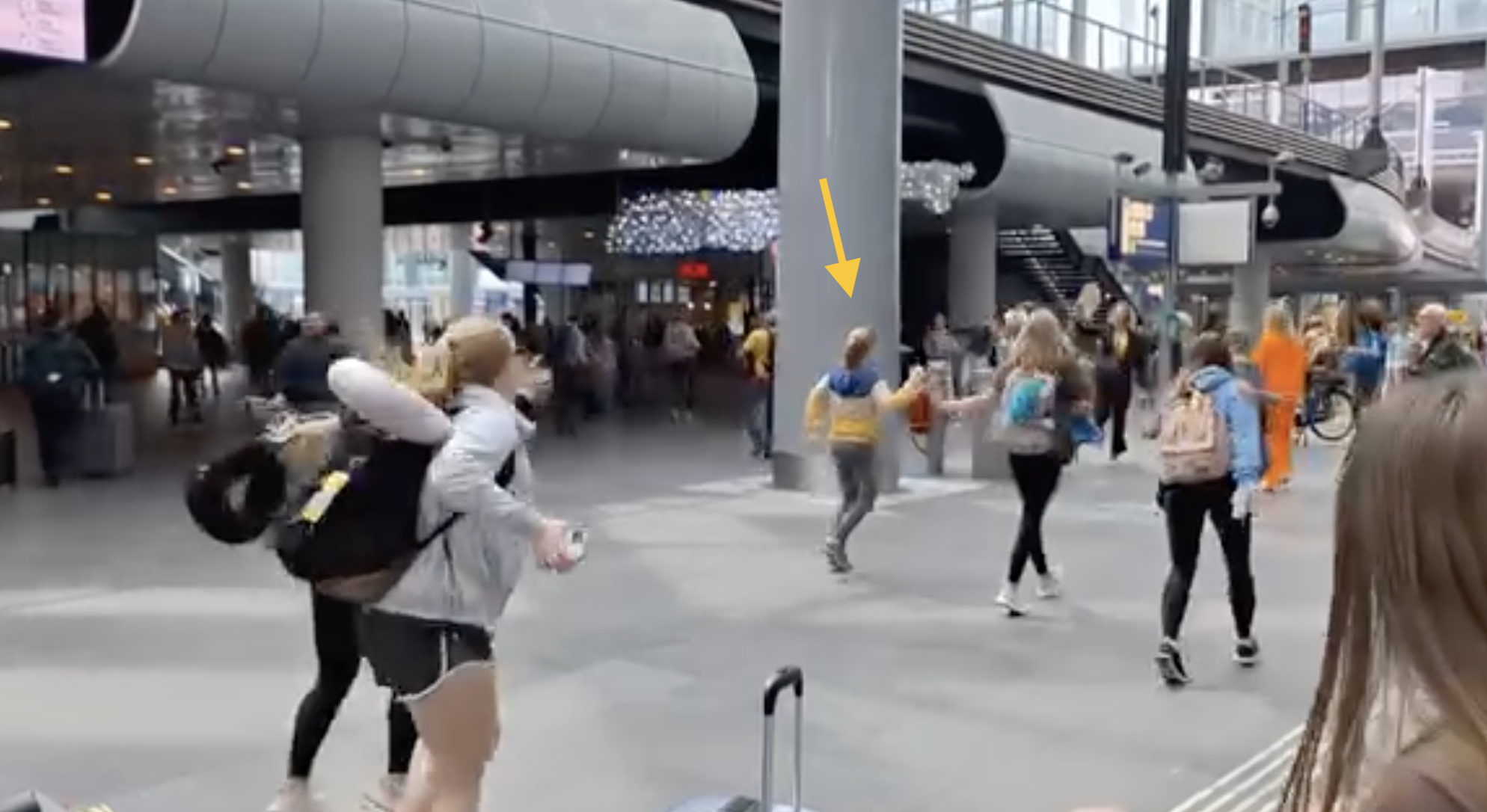
In my last post, I mentioned that I was able to co-lead a trip to Europe with Millersville students in May. What I didn’t mention was that shortly after arriving in the Netherlands, our group encountered a flash mob in the train station. A group of dancers had organized an interactive performance for commuters and travelers, eagerly inviting any passersby to join in. This dance struck me as distinctly European—their movements were so charmingly goofy and it seemed just as possible that it was choreographed as it was that it wasn’t.


I wasn’t the first in our group to notice it, but when I heard one of the students say something about a flash mob, I froze, dropped the luggage I had been hauling and ran back and forth like an over-excited cartoon for a few moments. I then sprinted closer to the dance and joined in immediately when prompted by an enthusiastic Dutch woman. My group, not yet willing to abandon me in Europe since we had been on the continent for only an hour or two, gradually moved in my direction and about half of the students joined in the dance as well.


I think that for most of our students, this was an amusing way to keep the jet lag at bay. Not for me. As I exclaimed to several of them while hopping around, “I honestly don’t have any more life goals!”


I wasn’t kidding. About ten years ago, if you’d asked me what my big hopes for my life were, I would have said, “I’d love to get married, I’d love to have children, I’d love to have a full-time job with a grownup’s salary, and I’d love to come upon a flash mob.” Check, check, check, and—as of this past May, check!


While the other three hopes were by no means guaranteed, I had at least some degree of agency in making them happen. But the beauty of a flash mob is that the spectators can’t plan it. The whole point of a flash mob is that it is a complete surprise to everyone except those organizing it. Everyone else can only go about their lives quietly hoping that one day they might stumble upon this most curious thing some of their fellow humans have chosen to do.


Most years, I try to write a blog entry during Advent, the period in the Christian calendar preceding Christmas. This year, that just… [insert the late end to my semester, a nasty respiratory virus, etc.] didn’t happen. So instead, I tried to revel in the 12 Days of Christmas which ends tonight (or tomorrow, depending on how you count them). Tomorrow is Epiphany, the day that Christians celebrate the arrival of the Three Kings in the Christmas narrative as well as the belief that God chose (and still chooses) to take on the form of humanity. And throughout this extended Christmas season, I have been thinking about flash mobs (that is, even more than I normally do!).


I’ve been thinking about the ways that the divine can break into our prosaic, everyday lives in totally unexpected ways. While the date of Christmas is obviously set on our calendars, the experience of God in humanity can’t be. Don’t get me wrong—I love the Advent and Christmas seasons, but if I were to map onto a calendar the times in my life when I believe I have experienced God’s presence in interaction with someone else, December and early January would by no means have a monopoly.  


I’ve been thinking about how both Christmas and flash mobs are pure gift; it’s as nonsensical to say that we can “earn Christmas” as it would be to say that spectators can “deserve a flash mob.” They just happen and we can choose whether or not to receive them gratefully when they come.


I’ve been thinking about what flash mobs do for and to those watching and about how two of the primary characteristics of God’s gifts are 1.) their inherent goodness and 2.) the way they encourage goodness in us. It is very hard to leave a flash mob unchanged in any way.


I’ve been thinking about how many flash mobs are expansive, starting with just one or two participants and then quickly growing to include dozens, even hundreds, and sometimes thousands of people. Some, like the one I encountered, actively encouraged participation from spectators. Whatever goodness we think the Christmas season signifies—hope, love, comfort, peace—surely it is meant to grow as we give and receive in relationship with each other.


I’ve been thinking about how, when flash mobs end, the participants typically walk away as though nothing at all had happened, as abrupt a return to the way things were as the performance was a disruption from them. Likewise, we are quick to return to business as usual after Christmas, and while participating in the extended celebration until Epiphany might delay that return somewhat, it must happen sometime. After we glimpse the extraordinary, we can worry that we have had our allotment of wonder and that everything afterward will be mundane by comparison.


Epiphany reminds us that even after the most stunning thing we could fathom—the divine becoming human—we should expect more. My experience in May of 2024 may have checked off my final life goal on my list, but if anything, it reminds me of the profound truth that flash mobs demonstrate: any place full of any people might be on the brink of something spectacular. And if I believe, as I do, that everyone has some spark of divinity in them, I must expect and look for God’s presence whenever I interact with anyone. In other words, knowing that at any given moment, a random stranger might be about to burst into an elaborate dance—partly as a gift to me and others—keeps my soul in shape.


Finally, I’ve been thinking about how flash mobs and the Christmas season both can challenge us to consider how we are gracing those around us with our talents, time, and imaginations. And this year, I’m realizing I need this dual challenge just as much, maybe more, after Christmas as I do before: how can I go into the next few weeks and months, as the decorations come down and routines go back to normal, expecting to encounter God in others and being open to God using me to serve others? Or, put another way, how can I internalize the well-known quote from St. Teresa of Ávila my pastor shared in church today:

Christ has no body but yours,
No hands, no feet on earth but yours,
Yours are the eyes with which he looks
Compassion on this world,
Yours are the feet with which he walks to do good,
Yours are the hands, with which he blesses all the world.


I’m not saying that you should go out and initiate a flash mob (to be clear, I’m not not saying that either!!). But what can you do to live in anticipation of astonishment even as your daily life plods on? And what can you do to give others reason to hope for the same from you?


For those who celebrate, Merry Christmas and Happy Epiphany (Hapiphany?), and to everyone, may 2025 be a year when goodness and joy spreads like… well, I’m sure you’ve gotten the picture by now. 😊


Sarah/Mouse


Ps: In case you are unfamiliar with flash mobs and would like to get a taste for them, here are some ones that I (and a lot of the internet) like:


  • Ode to Joy: My favorite. I dare you to watch this without tearing up a little.
  • Circle of Life: Can you imagine a more magical subway ride? The answer is no. No, you cannot.
  • Hallelujah Chorus: If you’re still in a festive mood and/or really like food courts.
  • Glee medley: This is one of several medleys that flash mobbers did using songs from the show Glee in various locations around Seattle. I especially like how this one includes so many people who are so clearly having a good time together.
  • Ohio State Union: A fun one for any OSU fans.